Collecting Time

The Archive of Sentiment: Fading
June 28, 2026
Shadowplay: What Light Conceals
July 23, 2026”Fashions pass quickly, and nothing is more pathetic than those puppets of fashion outrageously made up one day, pale the next, pleated or ironed stiff, libertine or ascetic. Playing with fashion is an art. The first rule is: don’t burn your wings.” — Yves Saint Laurent
– fascination with time –
Time. A set of instants, measured by minutes, that multiplicate themselves into hours, which later form a passage known as a day. Search as one may, one can hardly find a concept as abstract as that of time. We think of it almost always, we sense its passing, we count it (going forward, or moving backwards), yet we struggle to understand it. Although being familiar with the Proustian idea that “We feel in one world, we think and name in another. Between the two we can set up a system of references, but we cannot fill in the gap.”, that shall, at its core, persuade us from further trying to delineate it in a general definition (as, after all, intellectualisation is a common cover-up for fear of direct experience), what is left is but its narrating. For we undergo time only through the memories of the past events that we keep. A week full of novelty seems to be longer than a year of routine that, after a while, makes us experience its duration as flattened.
Faced with the issue of the inability to depict a notion, there are two possible paths of its further development. The first, most obvious, is putting it into art, which created the melting clocks, or memento mori skulls. The other, way more interesting, is the urge to avoid it — a pull to create something that breaks the laws of instants, and extends into eternity. Mostly used in design — of furniture, interiors, and fashion — the idea of timelessness preferably connects itself to that of “good taste”, following the logic that good taste simply means choosing objects that are valuable regardless of the trend. As Yves Saint Laurent put into words, “Fashion fades, style is eternal,” summarizing the difference between fleeting trends and enduring identity. Not only that, as a designer who “empowered women” that Coco Chanel had previously liberated, his designs followed the perspective of breaking with any traditional form of female dressing, introducing oversized and masculine suits in order to outline female elegance. His attempt to bypass the term that had fascinated him from an early age was seen in his addition to collecting. Together with his partner, Pierre Bergé, he was a curator of perhaps the most influential homes. Two of the greatest tastemakers of modern times curated, among others, Rue Bonaparte in Paris, Mas Théo in St Rémy de Provence, the Villa Léon l’Africain, and later the Villa Mabrouka, both in Tangier — all of which were distinctive expressions of the couple’s intense passion for collecting, and, nothing less important, taste. As the French poet Robert de Montesquiou (1855) compared the house in which one lives to a state of mind, each and every one of Saint Laurent’s homes can be seen as a façade of his inner psyche, which makes them only more intriguing to discuss.
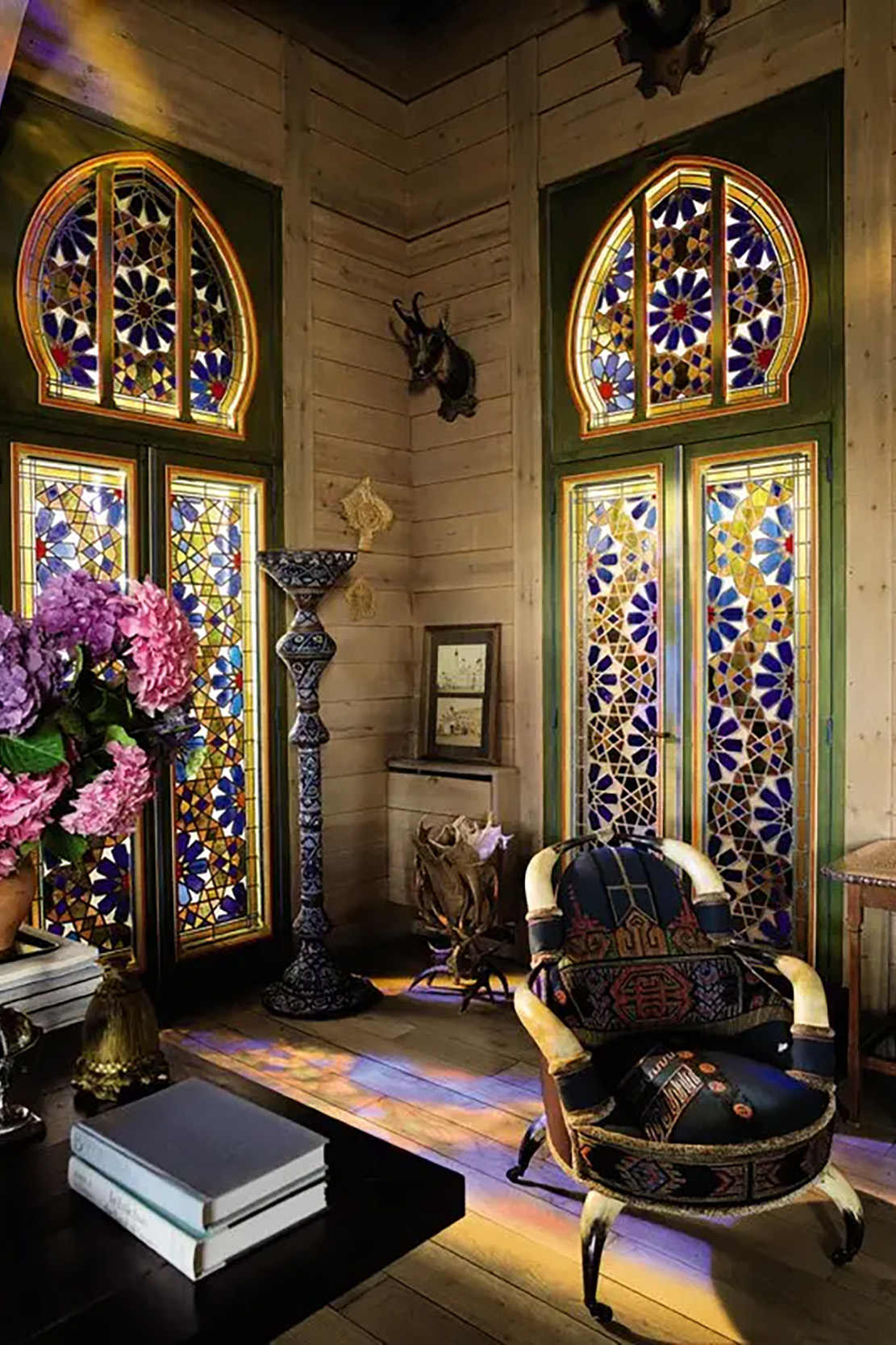
Drawing room, Château Gabriel
Photograph © Marianne Haas
The drawing room at Château Gabriel illustrates Yves Saint Laurent and Pierre Bergé's belief that an interior should be collected rather than merely decorated. Stained-glass windows inspired by Moroccan craftsmanship filter coloured light across European furniture, textiles, ceramics, and carefully chosen objects, dissolving the distinction between architecture, collecting, and daily life.
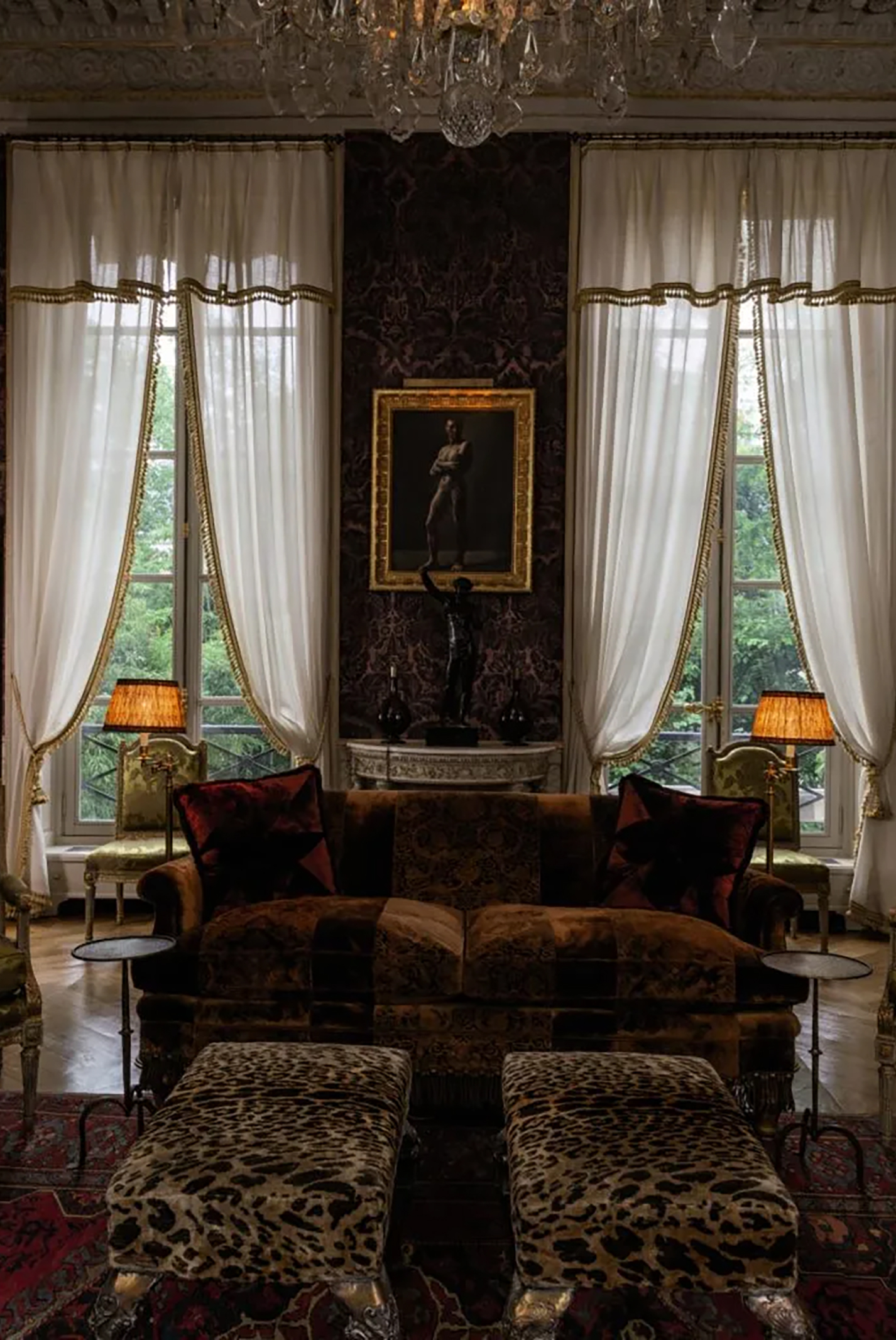
Salon, Rue Bonaparte, Paris
Photograph courtesy of Sotheby's Art Digital Studio
Rue Bonaparte demonstrates that collecting is not merely the acquisition of exceptional objects but the creation of relationships between them. Here, paintings, sculpture, furniture, and textiles cease to exist as isolated works and instead compose an atmosphere shaped by memory, beauty, and lived experience. The apartment became one of the clearest expressions of the shared eye of Yves Saint Laurent and Pierre Bergé, whose interiors were curated as carefully as any exhibition, yet always intended to be inhabited.
At the very young age, Yves discovered, and soon after became deeply affected by, the writings of Marcel Proust. À la recherche du temps perdu (Remembrance of Things Past, 1913) has remained, in the literal sense, the narrative illustration of the abstraction of time, capturing its absurdity in a single manifestation — memory. By blurring the clear border between the thought of a past event and the present moment (as the one already gone), Proust introduced the conceptual view of memory as the measure of time. Recollection, in his work, does not function as a faithful archive but as a patient editor. It continuously rearranges the material of a life, elevating certain details while allowing others to disappear. The significance of an event therefore lies not only in what happened, but in what remains. The time interval is measured not simply by duration, but by residue. Seen from this perspective, a life is composed less of years than of surviving impressions: a particular light falling across a room, the atmosphere of a city encountered for the first time, a sentence overheard and carried for decades. These fragments persist with a disproportionate force, occupying far more space within us than their brief appearance would seem to justify. Or, in the case of Proustian recapitulation, the smell of a madeleine resurrects the subject’s entire childhood in Combray, unlocking feelings of profound, unexplainable joy — the phenomenon that became recognised as a “Proustian moment” or a madeleine de Proust. An object, or in this case a smell, is a catalyst for involuntary memory, the kind whose details we fail to recall when trying to relive it. By and large, Proust compares the sudden reminiscence reappearing to Japanese paper flowers. The little cake crumb is like a folded scrap of paper; the tea is the water that makes it bloom into the town, gardens, and people of his youth. For Yves, precisely, this narration served more in the sense of personal resonance, for his creative vision was deeply anchored in his sunlit Algerian boyhood. Late in life, Yves frequently referenced Proust regarding his upbringing. Watching home footage of his Algerian youth, he noted: “I had a wonderful childhood... Now, I’m thinking of Proust who wrote: ‘True paradise is one you’ve lost."
Known for his eclectic, but exquisite taste, Bergé had a genuine relationship with objects, especially books and works of art with which he personally chose to surround himself. He was fond of them in the sense of recalling the past, as if, by collecting them, he was collecting souvenirs from distant or familiar places, or periods of his life. Together with Yves, he was building a unique space where art was not only seen, as in museums, but also put into a living context. The famous Dar el-Hanch, "The Snake House", which was a small house in the medina, was also the first place of gathering for the creative circle of the sixties. Rather than a formal exhibition, its “art collection” was an authentic mix of Moroccan treasures—Berber rugs, regional pottery, and Saint Laurent’s own famous winding snake mural painted on the dining room wall.
It was followed by Dar Es Saada, the “House of Happiness” in Marrakech, which, decorated by Bill Willis, brought Islamic art into the stage of living reality. Antique Moroccan furniture and bright zellige (mosaic tilework) served as atmospheric inspiration to the couturier’s professional life, but to his social one as well. The myth of the Swinging Sixties, and especially the circle around the two collectors, remained so intriguing decades later, notably because it seemed almost surreal in its intention of melting reality with beauty. The same myth followed all their art: paintings by Henri Matisse, Pablo Picasso, and Piet Mondrian, Brancusi’s sculptures, Art Deco furniture, Roman cameos, and Baroque and Chinese bronzes were not put together for private and secret admiration—they were shared, and lived around, making them even more timeless.
Similar to the idea from the inception that we add “life to our days”, while we are unable to do it the other way round, the artwork seems to be valued more if it was experienced in an actual environment. Maybe the closest example can be said to be Claude Lalanne’s mirror, which indeed played a significant role in the assemblage, as it seems almost to have seen the fragments of the lives of the people who made history. For, presumably, every next possessor is attracted to and driven towards an object because of its historical belonging, not only because of its creator’s name. Following not only inspiration, but the very connection to Proustian literature, art, once put into an applied setting, takes the form of a “Madeleine de Proust”. Precisely for the collector himself, as time passes, the object remains as the bound-to-happen souvenir of instants, conversations, or even people themselves. Observing an artwork, and making it a passive object of admiration in isolation, makes it lose a great deal of its beauty. In and of itself, the capacity it holds is to remind us of both: its own history, and that of its owner.
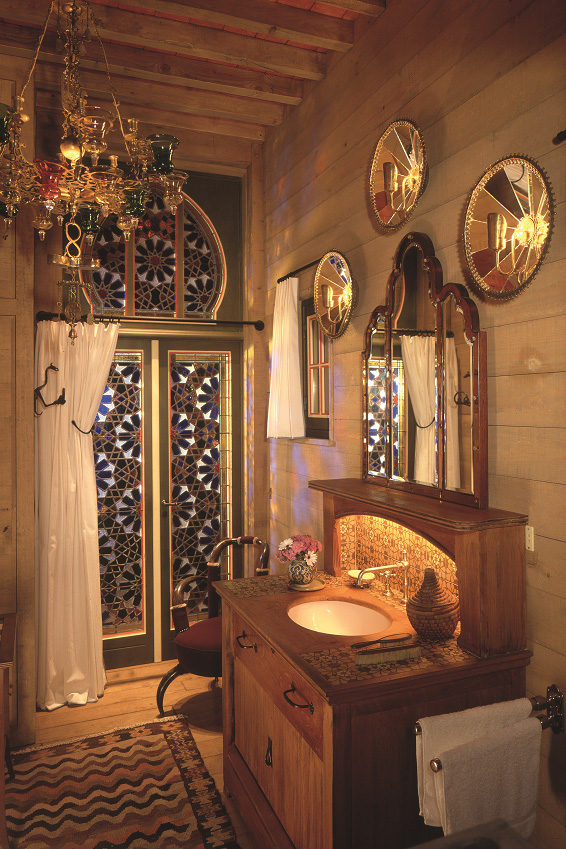
The bathroom at Château Gabriel
Photograph © Marianne Haas
Like their homes in Marrakech and Tangier, Château Gabriel demonstrates how everyday life became the setting through which beauty, memory, and collecting were continuously experienced rather than simply observed.
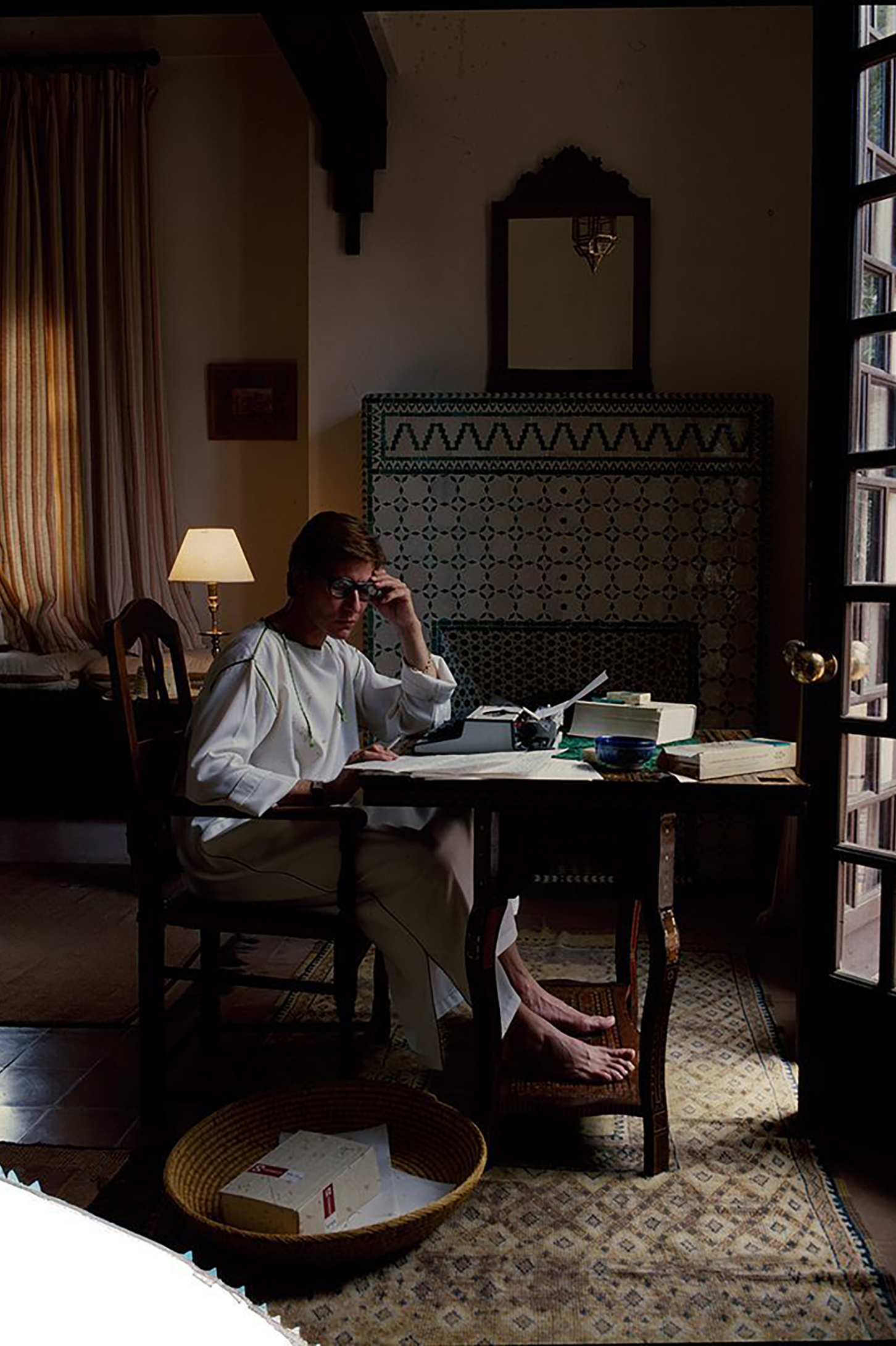
Yves Saint Laurent working at his desk at Dar Es Saada, Marrakech, 1980
Photograph by Horst P. Horst. © Condé Nast via Getty Images
– on collection –
There is a certain desire to keep the past, almost to possess it, by owning a work of art. As seen in numerous collectors’ arrays, the “immortality” of objects is what is looked for when placing them inside homes. Ernest Becker simplified it, arguing that almost everything individuals do, from building things, making art, having children, to accumulating beautiful objects, is, at its root, a response to the knowledge that we will die. That knowledge is so unbearable that entire lives are spent constructing ways to feel like we’ll outlast ourselves. He called them immortality projects, holding the statement that a single item, at least through a slightly poetical lens, “remembers” its past — and brings with it the recollection of all that has happened around it. This is what occurs with sculptures positioned in public places. By observing them, we enter into a dialogue with the past. For every corner of every city has seen lives and tales before our time, the ones we’ll never know because they haven’t been written about. But, looking at the statue, we hold the impression of almost hearing the whispers of those intimate tellings, which is, for someone addicted to the past, in a way, precious. There is, however, another layer that brings collectors close to objects — one way more rational, and way less romantic. Every object has meaning. It represents something now, but it indicated something else in the past, and, naturally, the same can be said, even debatably predicted, for the future. If one sees oneself less as a connoisseur of sentiments and narrations, one certainly does align with the allure of significance.
The Moroccan houses reveal an unusual principle of collecting. Rather than searching for masterpieces, Saint Laurent and Bergé searched for continuity. A seventeenth-century Islamic ceramic did not enter the room because it was exceptional, but because the cobalt of its glaze continued into the blue of Majorelle, echoed the geometry of a zellige floor and found its counterpart in the lapis background of a Matisse. A silver Amazigh fibula answered the chiselled bronze of an Art Deco lamp; a coarse tribal textile absorbed the severity of French furniture until both appeared quieter together than apart. Historical periods dissolved in favour of visual kinship. European modernism ceased to be European, Moroccan craft ceased to be ethnographic, and each object was relieved of the obligation to represent its origin. Instead, it participated in a larger composition whose true subject was atmosphere. The collector’s task therefore resembled less that of an accumulator than of a conductor, arranging correspondences between materials, colours and forms until the house itself acquired an internal rhythm. It is perhaps here that one senses the deepest affinity with Proust. If memory is never recovered by an isolated sensation but through an entire constellation of impressions, then the Moroccan interiors functioned as spatial madeleines: not a single object, but an orchestration of colour, texture, light and proportion capable of preserving the emotional climate of a life. following Saint Laurent’s death, auctioned the 733-piece collection at the Grand Palais set a world record by selling for $483.8 million by Christie’s, being named the “Sale of the Century.”
– epilogue –
The desire to extend beauty into eternity comes in the aspect of personal relations, too. Especially the ones of deep connection on both the intellectual and emotional fields, often known as partnerships, as it was the case with the two curators. “I ask myself where I found the time to collect all these objects and paintings. I think it’s admirable, and my choice of word is not exaggerated, that our tastes never clashed,” Bergé wrote in a letter to Yves after his death. “Deep down, our collection and our house were the greatest proof of our love for one another.” In and of itself, that which is not defined tends to fascinate us and, simultaneously, scare us to death.
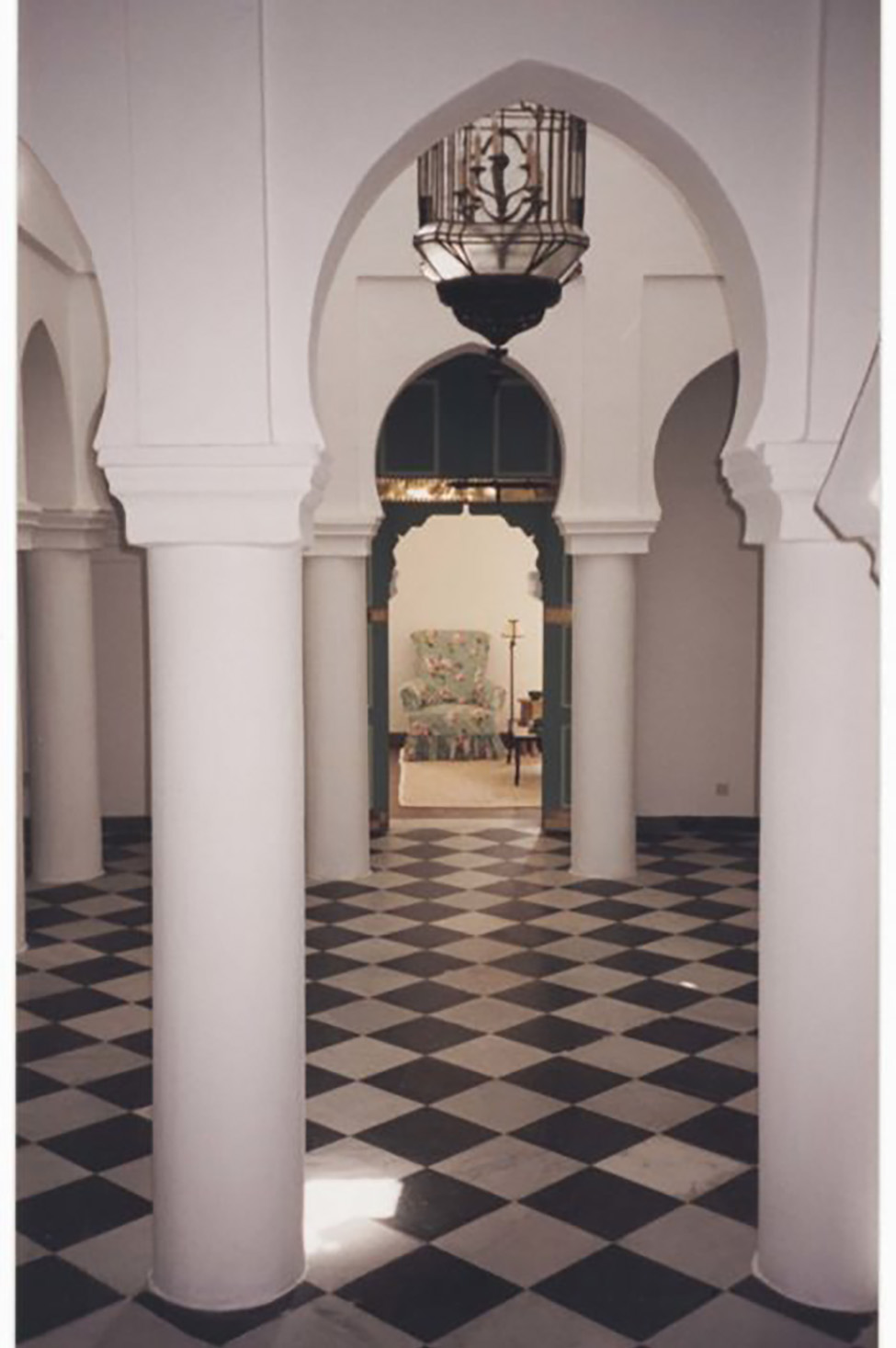
Interior of Villa Mabrouka, Tangier
© Droits réservés
Acquired in 1997, Villa Mabrouka became Yves Saint Laurent and Pierre Bergé's final Moroccan residence. Overlooking the Strait of Gibraltar, the house embodied a quieter vision of collecting, where Moorish arches, geometric floors, restrained white walls, and carefully selected furnishings allowed architecture itself to become part of the collection. Rather than overwhelming the eye, the interiors frame each object with deliberation, revealing the couple's enduring preference for harmony over abundance.
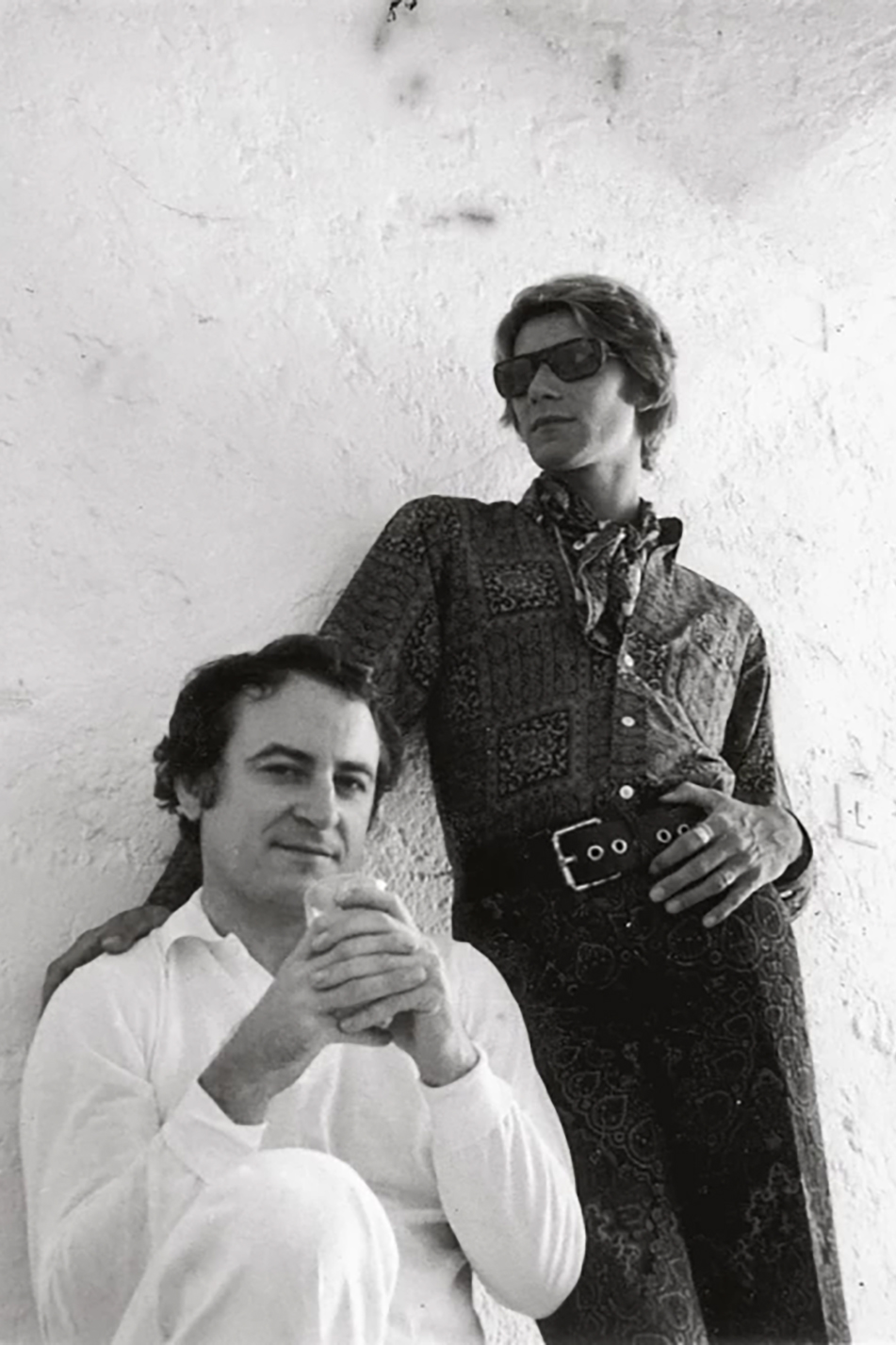
Pierre Bergé and Yves Saint Laurent, Marrakech, c. 1960s
Photograph © Fondation Pierre Bergé – Yves Saint Laurent
“One morning we awoke and the sun had appeared. A Moroccan sun that probes every recess and corner... We would never forget that morning, since, in a certain way, it decided our destiny.” – Pierre Bergé
Words by Greta Wolff
Yves Saint Laurent’s Collections Through the Lens of Proust