The Return of the Dream

Coolness, After Rebellion
April 28, 2026
The Archive of Sentiment: Fading
June 28, 2026"Interpretive delirium begins only when man, ill-prepared, si taken by a sudden fear in the forest of symbols."
— André Breton, L’Amour fou
Surrealism. The figurative tendency of the 20th-century art movement was oriented towards the inner world — towards dreams, the unconscious, and thoughts. After the whole of art history’s documentation of either living reality, or told narrations, the last figurative attempt turned to inward reality, following the thought that, unless painted, it couldn’t be seen by others. Artists, such as Salvador Dalí, René Magritte or Giorgio de Chirico were capturing absurd scenes, believing in that superior actuality of forms of association heretofore abandoned, in the omnipotence of the dream, and in the disinterested play of thought.
The artist’s direction of his consciousness, as René Magritte understood it, is oriented towards life itself, rather than ideas, making art a byproduct of life, even the dreamed one. As probably the most intriguing still, he portrayed time in Time Transfixed (La durée poignardée, The Art Institute of Chicago, 1938), where nothing seems to be happening (nor, one suspects, will ever happen). The dreamlike atmosphere is created by the sensation of the natural laws of time and space ceasing to apply, provoking the thought, or rather say fascination, with the hidden drives that, although not consciously part of the mind, influence one’s behaviour and, therefore, life itself. The Surrealists, even on the surface seeming only dreamy, in fact were facing the darker parts of the mind. For their attempt was to find and to fix "the point at which life and death, the real and the imagined, past and future, the communicable and the incommunicable, high and low, ceased to be perceived as contradictions." The fascination with uncanniness, traumas, even fetishism, was the drive behind the irrational figurations. As Salvador Dalí noted while discoursing about his painting The Enigma of Desire – My Mother, My Mother, My Mother (Pinakothek der Moderne, Munich, 1929,): “It is not me who is the clown, but this monstrously cynical and so unconsciously naive society, which plays the game of seriousness in order better to hide its madness.”
— Return of Dreams—
Exactly 100 years after André Breton published his Manifesto, the desire to capture the inner world has become visible once again. In media known as the return of figuration, what we see in the ongoing artistic expression is actually the return to the painted documentation of dreams. Artists such as Anna Weyant, whose figurative paintings, influenced by the Dutch Golden Age, show an awareness of contemporary popular culture and social media, or Wolfe von Lenkiewicz, capturing ambiguous compositions that question art historical discourses, bring back the uncanniness. Only, this time, the feeling is far less disturbing, remaining more atmospheric. While the Unheimlich (the uncanny) was usually described as the sensation of waking up in the middle of the night, not knowing whether one has awakened or is still dreaming, the paintings of the mentioned authors provide the same sentiment by keeping the very subject unclear. The viewer, plainly, sees the scene, but its very origin remains unknown. Is it real? A projection? A dream? Or a deeper meaning known only to the author himself?
The return of figuration aims not to show reality, but to visualise experiences that reality itself cannot contain.
The hyperreal has all along been the starting point of actuality. The images, the pretences, have taken over the experience’s nature of being kept in memory, so that events, connections, even conversations are held with the point of documenting them, and showing them to the public rather than fulfilling their purpose in exchanging the moment. Once the digital has integrated into the living, and the border between what has happened factually and what was staged became non-existent, the only point of safety, or authenticity, has turned towards an author’s thoughts. At the point where what one thinks of is as real as what one sees, or experiences, (while something might not be real just because one sees it), painting, as it has been throughout history, has turned towards the welfare of the mind. Somewhat ironically, the mere possibility of diving inside one’s thoughts seems to be the fascinating path of art, similar to écriture automatique, which became, in the moment it was “invented”, the synonym for intellectual capacity.
Much of what previous generations needed painting to preserve can now be captured effortlessly. Faces, events, places and objects can all be documented with unprecedented precision. Yet the inner image remains resistant to such capture. A dream, a mental association, a projection, an atmosphere felt rather than understood, cannot be fully photographed nor completely translated into words. It remains visual. It is perhaps here that painting discovers its renewed territory.
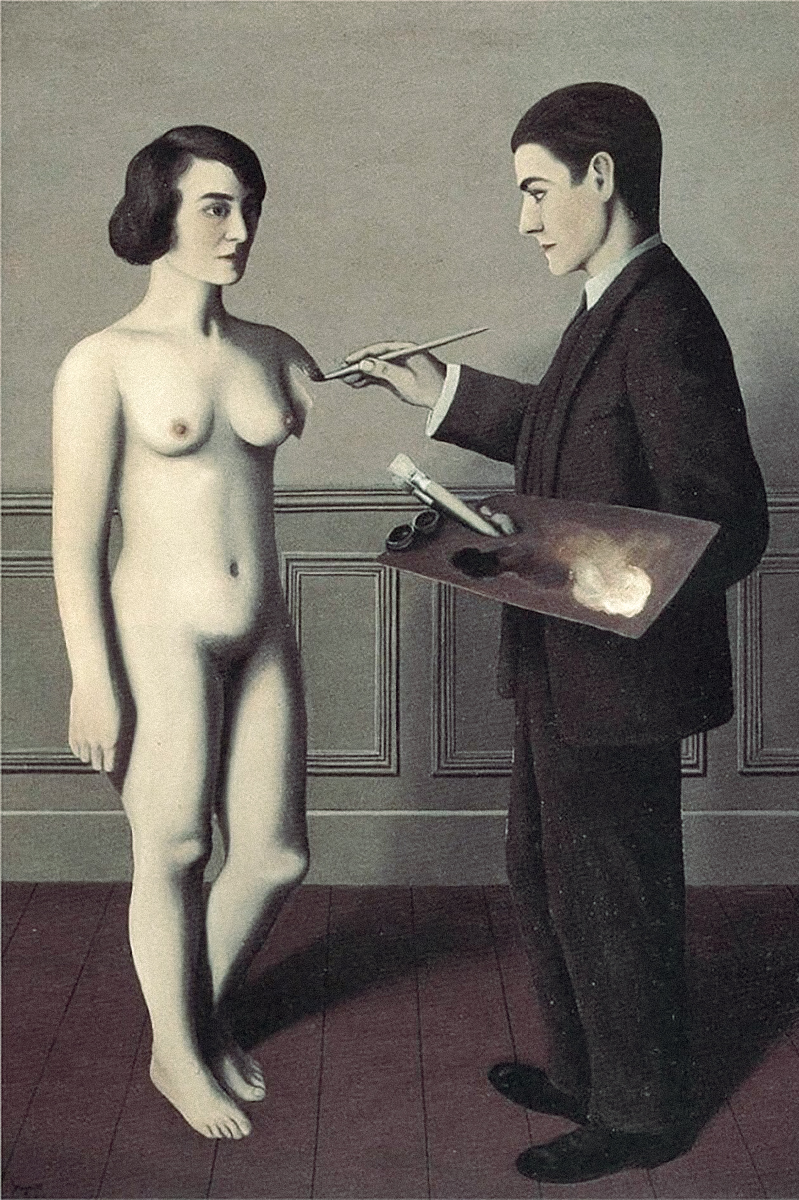
Attempting the Impossible (1928) is one of René Magritte's most poetic reflections on creation itself. In just a few lines, the work suggests that every creative act is an attempt to give form to something that does not yet exist. The "impossible" is not failure, but the enduring human desire to transform an idea into reality—a quiet meditation on art, imagination, and the mysterious power of making.
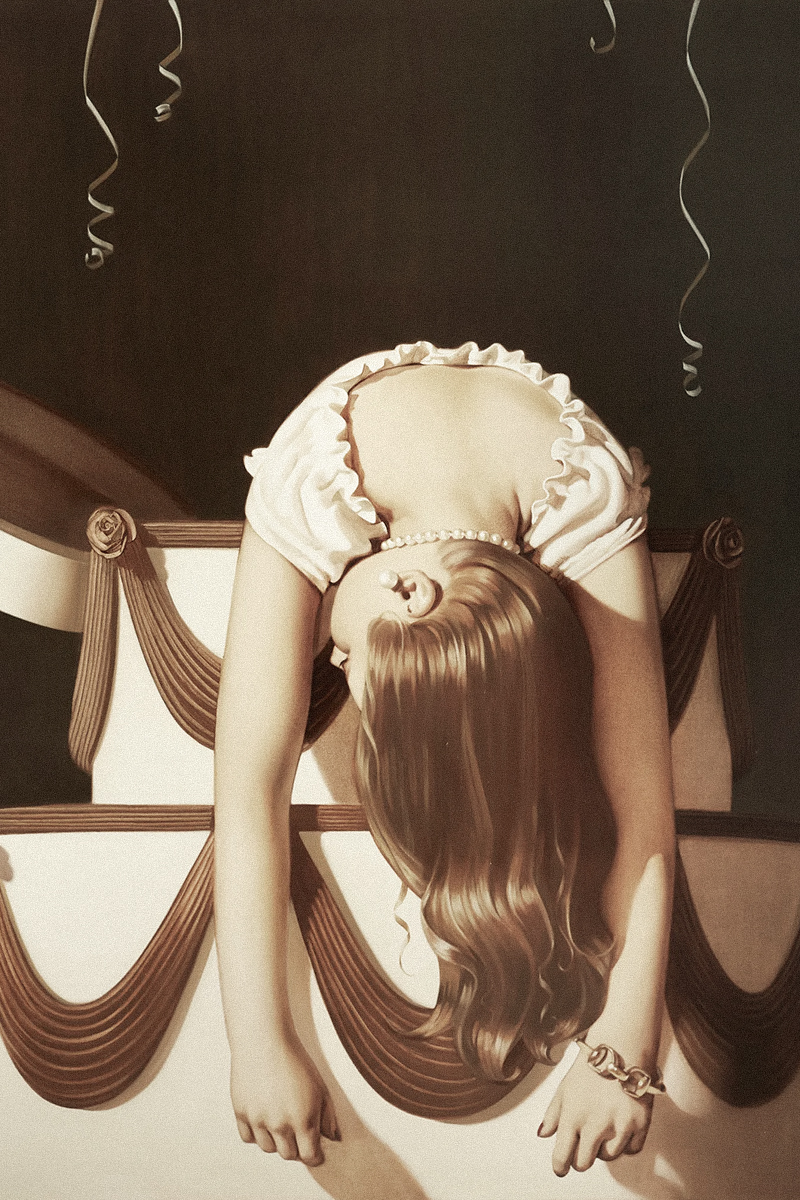
Anna Weyant, Feted (2020). The image captures many of the qualities that have made Weyant's work distinctive: a technically refined, Old Master-inspired surface paired with an unsettling contemporary narrative. Rather than depicting a dramatic event, Weyant often paints what she has described as moments of "low-stakes trauma": everyday psychological unease rendered with cinematic precision and dry humor.
— When Reality Was No Longer Enough —
The invention of photography has brought painting to the existential question: once reality can be captured precisely as it is, what is the true meaning of art? Photography, in certain words, freed Western painting from its obsession with realism, allowing it to develop as an autonomous medium. Before its invention, painting was torn between two ambitions: expressing spiritual reality and duplicating the world, with the latter, a “need for illusion,” dominating. Once facing its very meaning, painting turned towards abstraction, with its most compelling Jackson Pollock expressions, Mark Rothko emotional interpretations, and Donald Judd minimal objects. With Hal Foster pointing out that figuration has re-entered painting again — but not in narrative form, as if the traumatic has never left art at all, and its final formation is the figurative one, as seen in the works of Andy Warhol (whom Foster assumed captured trauma fading due to repetition). Yet, after this kind of form, the one we are witnessing now is looking towards interiority in the sense of imagination, taking as its starting point that certain things, such as the distressing lead of lives, have already faded through earlier periods of modern history, opening space towards the dreamy — the softer attempt to communicate interiority. The difference between the two mediums is one that Man Ray put into words observing his own images: “I photograph the things that I do not wish to paint, the things that already have an existence.”
The shown, once away from the negative aspects of the unconscious mind, still holds the uncanniness merely in the confusion of what is visible. The scene, the people in it, the objects, colours, all feel a little off. Nothing is visibly wrong with it (there are no melting clocks, or apple-faced men), yet there is something about it suggesting its belonging to another life: the author’s inner one. Almost cinematic painting, its power lies in suggesting an emotional connection with the observer. When looking back at abstraction in art, its meaning, if one has to search for such, was precisely in illustrating sentiments (for reality could have been captured in photography, but such things as melancholy, sadness, or hope still needed a different artistic interpretation). Rothko’s colour field paintings, which depicted irregular and painterly rectangular regions of colour, make people feel something directly, without a narrative provided, creating a new emotional reality. The same level of connection between the painting and the observer can be experienced through the given story — because figuration, in the sense of modern Surrealism, uses the scene to transmit a deeper sentimental state, which is, in this sense, not even a personal one, but rather the general anxiety towards the society and digital angst we live in.
Photography and digital imagery are everywhere, leaving painting no longer competing with photography. Instead it becomes a space for imagination again. Figuration follows the function of interpretation, not documentation. For the scenes that ask for documentation today are those of fast consumption, and of the nature of quick forgetting. The cultural relationship with images has long been the exact manifestation of Susan Sontag’s “Social change is replaced by a change in images. The freedom to consume a plurality of images is equated with freedom itself.” Quite possibly, the nature and instinct for taking (and captivating) everlasting, endless evidence of moments that we never return to, after a while of such behaviour, makes us interested in something hidden — such as an imagined world that no one can see aside from the author himself. Painting asks for longer attention. Together with the dedication of the artist in the process of making it comes the same urge in the viewer to look at it longer, to observe the technique, details, and to leave thoughts to construct the story around it. Écriture automatique has never left, for the moment when art connected with dreams, the two worlds interpreted in a single movie-like painting — as well as the fast consumption of documented moments and staged pictures — has revealed the need to narrate again.
— Nature of Dreams —
The nature of dreams is, at its core, very similar to écriture automatique. Text is produced without conscious intent, with words following thoughts without questioning them, without changing or adapting them. In the three principal Breton novels, Nadja, Les Vases communicants, and L’amour fou, objects are “rare,” places “strange,” meetings “sudden,” yet all are haunted by repetition. So is Breton, to the point where he experiences being itself as haunting. “Perhaps my life is nothing but an image of this kind.” he writes early in Nadja; “perhaps I am doomed to retrace my steps under the illusion that I am exploring, doomed to try and learn what I should simply recognize, learning a mere fraction of what I have forgotten”. Contemporary painting captures this dreamy sequence particularly well. In essence, the “reverie” is made of uncontrolled events, as automatic writing follows untamed words — leaving coincidence to play the leading part in the narration. The irrational images, in the whimsical context, seem as possible and as “rational” as levitation in Von Wolfe’s Measured Silence (2025).
In Nadja (1928), where Breton charged that “madmen are made there,” putting the blur on the separation between illusion and reality (and one’s very capacity to distinguish parts of observation that belong to reality from those made by imagination). As he is keen to point out, madness, although seen as an essential part of Surrealism, here references the Unheimlich moment itself. Nevertheless taking the form of being unable to differ whether one has dreamt or the dream was actual, a similar impression is felt in the observed paintings. Purely because of the contradiction that, maybe more than in the original time, contemporary artists put in front of the viewer: by watching the uncanniness of a seemingly common image, aside from questioning the seen, we start questioning the ability to perceive things clearly. Ever since the Freudian conclusion that even the most disturbed mind follows certain regulations, the joke of putting the observer in the position of questioning his own instinct is experienced as both: slightly provocative and unexpectedly mysterious. By observing Paul Delvaux’s Landscape with Lanterns (The Albertina Museum, Vienna. The Batliner Collection, 1958) — although he only briefly identified with the Surrealist movement — the observer witnesses a dream-like scene of a nocturnal landscape and the figure of a mysterious woman. From the first glance there is something to be felt, rather than understood. Only a few instants later, he notices the body being carried away, becoming aware of the actual scene he is looking at. The telephone lines dangle after being cut, indicating that communication between the land of the living and the dead is impossible. There comes the rationalisation of the Unheimlicher Traum — because once translated into the world of words, the painting looks even more like a documentation of a dreamt sequence rather than an actual night. And the intrigue comes precisely from the fact that we cannot be completely sure.
Nevertheless, painting transforms that urge of conservating the moment into the preservation of an imaginary sequence. Noting it in Anna Weyant’s portraits, which slightly break the physical laws of logic, what draws attention and remains afterwards is the impression of holding a part of reality that, at least according to Werner Heisenberg as well as George Berkeley, is as real as the one we witnessed ourselves. Lest we forget, actuality, in the same way as the dream, tends to become, with the passing of time, a memory in our minds. Once translated into the world of language, both the real and the imagined become notions. Art, especially painting, for decades has been following the conceptual temptation to produce ideas.
Italian below
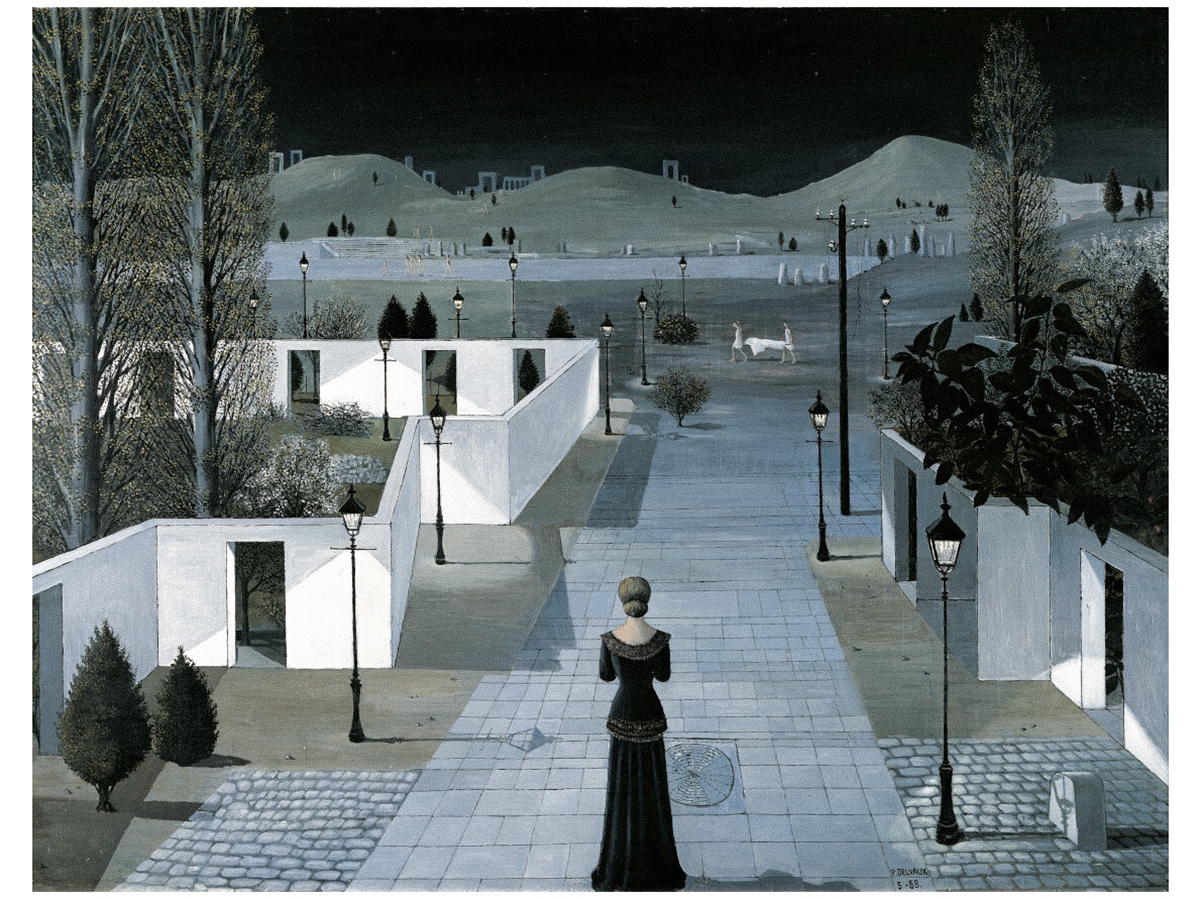
Paul Delvaux, Landscape with Lanterns (1958, Albertina Museum, Vienna). The painting is a quintessential Delvaux scene: a silent, moonlit landscape where architecture, street lamps, and distant figures create a dreamlike sense of suspended time. A solitary woman, seen from behind, becomes both protagonist and witness, inviting the viewer into a world where perspective is meticulously ordered yet psychologically enigmatic. Rather than narrating an event, Delvaux constructs an atmosphere in which familiarity and estrangement coexist
"Il delirio interpretativo comincia soltanto quando l’uomo, impreparato, viene colto da una paura improvvisa nella foresta dei simboli."
— André Breton, L’Amour fou
Surrealismo. La tendenza figurativa del movimento artistico del Novecento era orientata verso l’interiorità: verso il sogno, l’inconscio e il pensiero. Dopo secoli in cui la storia dell’arte aveva documentato il mondo visibile o tradotto racconti in immagini, l’ultima grande svolta della figurazione si rivolse alla realtà interiore, seguendo l’idea che ciò che accade nella mente, se non viene dipinto, resta invisibile agli altri. Artisti come Salvador Dalí, René Magritte e Giorgio de Chirico rappresentavano scenari assurdi, credendo in quella "realtà superiore" delle associazioni fino ad allora abbandonate, nell’onnipotenza dell’esperienza onirica e nel libero gioco del pensiero.
L’orientamento della coscienza dell’artista, come lo intendeva René Magritte, è rivolto alla vita stessa piuttosto che alle idee, facendo dell’arte un sottoprodotto dell’esistenza, persino di quella sognata. In una delle sue opere più enigmatiche, La durée poignardée (Time Transfixed, The Art Institute of Chicago, 1938), egli raffigura il tempo in una situazione in cui nulla sembra accadere — né, si sospetta, accadrà mai. L’atmosfera irreale nasce dalla sensazione che le leggi naturali dello spazio e del tempo abbiano cessato di valere, suscitando una riflessione, o forse una fascinazione, per quelle forze nascoste che, pur non appartenendo alla sfera cosciente della mente, influenzano il comportamento umano e, di conseguenza, la vita stessa.
I surrealisti, per quanto possano apparire semplicemente sognanti in superficie, erano in realtà impegnati a confrontarsi con le regioni più oscure della psiche. Il loro tentativo consisteva nel trovare e fissare «quel punto in cui vita e morte, reale e immaginario, passato e futuro, comunicabile e incomunicabile, alto e basso cessano di essere percepiti come contraddizioni». L’interesse per l’inquietante, per il trauma e persino per il feticismo costituiva il motore di queste figurazioni irrazionali. Come osservò Salvador Dalí parlando del suo dipinto L’enigma del desiderio – Mia madre, mia madre, mia madre (1929, Pinakothek der Moderne, Monaco): "Non sono io il clown, ma questa società mostruosamente cinica e inconsciamente ingenua, che recita la parte della serietà per nascondere meglio la propria follia".
– Ritorno dei sogni –
Esattamente cento anni dopo la pubblicazione del Manifesto di André Breton, il desiderio di dare forma al mondo interiore è tornato a manifestarsi. Ciò che viene comunemente definito “ritorno della figurazione” appare, in realtà, come il ritorno a una documentazione pittorica dell’esperienza onirica. Artisti come Anna Weyant — le cui tele figurative, influenzate dalla pittura olandese dell’Età dell’Oro, rivelano una consapevolezza della cultura pop contemporanea e dei social media — oppure Wolfe von Lenkiewicz, autore di composizioni ambigue che interrogano la storia dell’arte, riportano in scena il perturbante. Questa volta, tuttavia, la sensazione risulta meno destabilizzante e più atmosferica. Se l’Unheimlich veniva tradizionalmente descritto come quella condizione in cui ci si sveglia nel cuore della notte senza sapere se si è realmente desti o ancora immersi nel sogno, le opere di questi autori generano un’impressione analoga mantenendo indefinita la natura stessa di ciò che mostrano. L’osservatore vede chiaramente la scena, ma la sua origine rimane oscura. È qualcosa di reale? Una proiezione? Una fantasia? Oppure un significato più profondo accessibile soltanto all’autore?
Il ritorno della figurazione non mira a mostrare il reale, bensì a rendere visibili esperienze che il reale stesso non riesce a contenere.
L’iperreale è diventato il punto di partenza dell’esperienza contemporanea. Le rappresentazioni, le messe in scena, hanno progressivamente sostituito la natura stessa del ricordo: eventi, relazioni e perfino conversazioni vengono vissuti con l’obiettivo di essere registrati e mostrati a un pubblico, più che per il loro significato nel momento dello scambio. Nel momento in cui il digitale si è integrato completamente nella vita vissuta e il confine tra ciò che è realmente accaduto e ciò che è stato costruito è diventato quasi impercettibile, l’unico luogo rimasto per autenticità e certezza si è spostato verso il pensiero individuale. Quando ciò che immaginiamo appare tanto reale quanto ciò che vediamo o sperimentiamo — mentre ciò che vediamo non è necessariamente reale solo perché appare davanti ai nostri occhi — la pittura sembra essersi nuovamente orientata verso la dimensione mentale. In modo quasi paradossale, la semplice possibilità di addentrarsi nei propri pensieri sembra oggi rappresentare una delle direzioni più affascinanti dell’arte. Qualcosa di simile a quanto accadde con l’écriture automatique, che nel momento della sua formulazione divenne quasi sinonimo di capacità intellettuale.
Gran parte di ciò che le generazioni precedenti affidavano alla pittura per essere conservato può oggi essere registrato senza alcuno sforzo. Volti, eventi, luoghi e oggetti possono essere documentati con una precisione senza precedenti. Eppure l’immagine interiore continua a sottrarsi a questa possibilità di cattura. Un sogno, un’associazione mentale, una proiezione, un’atmosfera percepita più che compresa, non possono essere fotografati integralmente né tradotti del tutto nel linguaggio. Rimangono, nella loro essenza, fenomeni visivi. È forse proprio qui che la pittura scopre un nuovo territorio.
—Quando la realtà non bastò più—
L’invenzione della fotografia ha posto la pittura di fronte a una questione esistenziale: se la realtà può essere registrata con assoluta precisione, quale diventa il significato dell’arte? In un certo senso, il mezzo fotografico ha liberato la pittura occidentale dalla sua ossessione per il realismo, permettendole di svilupparsi come linguaggio autonomo. Prima della sua comparsa, la pratica pittorica oscillava tra due ambizioni: esprimere una realtà spirituale oppure duplicare il mondo visibile, con quest’ultima — quel "bisogno di illusione" — destinata a prevalere. Confrontandosi con il proprio significato, la pittura si rivolse all’astrazione, trovando alcune delle sue espressioni più significative nelle superfici gestuali di Jackson Pollock, nelle interpretazioni emotive di Mark Rothko e negli oggetti minimali di Donald Judd. Hal Foster ha osservato come la figurazione sia successivamente rientrata nel campo pittorico, ma non in forma narrativa, quasi che il trauma non abbia mai realmente abbandonato l’arte e che una delle sue configurazioni finali resti proprio quella figurativa, come suggeriscono le opere di Andy Warhol, nelle quali Foster individua un trauma progressivamente svuotato attraverso la ripetizione. La forma che osserviamo oggi, tuttavia, sembra orientarsi verso l’interiorità intesa come immaginazione. Muove dal presupposto che alcune tensioni — come il peso angosciante dell’esistenza che ha attraversato diverse stagioni della modernità — abbiano già trovato espressione, lasciando spazio a una dimensione più onirica: un tentativo più morbido e atmosferico di comunicare l’esperienza interiore. La differenza tra i due mezzi fu sintetizzata da Man Ray riflettendo sulle proprie immagini: "Fotografo le cose che non desidero dipingere, le cose che esistono già."
Una volta allontanatasi dagli aspetti più oscuri dell’inconscio, questa nuova figurazione continua comunque a conservare una forma di perturbante, che nasce semplicemente dall’ambiguità di ciò che appare. La scena, i personaggi, gli oggetti, i colori: tutto sembra leggermente fuori asse. Nulla appare apertamente sbagliato — non vi sono orologi che si sciolgono né uomini dal volto coperto da mele — eppure qualcosa suggerisce che ciò che stiamo osservando appartenga a un’altra vita: quella interiore dell’autore. Quasi cinematografica, questa pittura trova la propria forza nella capacità di suggerire un legame emotivo con l’osservatore. Se si guarda retrospettivamente all’astrazione, il suo significato — qualora si voglia cercarne uno — consisteva proprio nel dare forma ai sentimenti. La realtà poteva ormai essere affidata alla fotografia, ma stati d’animo come malinconia, tristezza o speranza continuavano a richiedere un diverso tipo di interpretazione artistica. Le campiture cromatiche di Rothko, composte da ampie regioni rettangolari dai contorni vibranti e irregolari, producono una risposta emotiva diretta, senza bisogno di una narrazione esplicita, generando una nuova realtà affettiva. Lo stesso grado di connessione tra opera e osservatore può essere raggiunto attraverso la storia suggerita dalla figurazione contemporanea, poiché il Surrealismo odierno utilizza la scena per trasmettere uno stato emotivo più profondo che, in fondo, non è nemmeno individuale, ma riflette un’inquietudine collettiva nei confronti della società e dell’angoscia digitale che caratterizzano il presente.
La fotografia e l’immaginario digitale sono ormai ovunque, e la pittura non è più costretta a competere con essi. Diventa invece, ancora una volta, uno spazio per l’immaginazione. La figurazione assume una funzione interpretativa piuttosto che documentaria. Le situazioni che oggi richiedono di essere registrate appartengono infatti alla logica del consumo rapido e dell’altrettanto rapido oblio. Il nostro rapporto culturale con le immagini sembra incarnare perfettamente l’osservazione di Susan Sontag: "Il cambiamento sociale viene sostituito da un cambiamento delle immagini. La libertà di consumare una pluralità di immagini viene equiparata alla libertà stessa." Forse proprio l’impulso a produrre prove incessanti e apparentemente eterne di momenti ai quali non faremo mai ritorno finisce, col tempo, per suscitare interesse verso ciò che rimane nascosto: un mondo immaginato che nessuno può vedere se non il suo autore. La pittura richiede una durata diversa dell’attenzione. Alla dedizione necessaria per realizzarla corrisponde nello spettatore il desiderio di soffermarsi più a lungo, osservare la tecnica, i dettagli, e lasciare che il pensiero costruisca una narrazione attorno a ciò che vede. L’écriture automatique non è mai realmente scomparsa. Nel momento in cui l’arte ha intrecciato il proprio linguaggio con quello del sogno — riunendo due mondi all’interno di un’unica visione quasi cinematografica — e parallelamente assistendo al consumo accelerato di momenti documentati e immagini costruite, è riemersa la necessità di narrare.
— Natura del sogno—
La natura del sogno presenta, nella sua essenza, una profonda affinità con l’écriture automatique. Il testo nasce senza un’intenzione cosciente: le parole seguono il flusso del pensiero senza essere interrogate, corrette o adattate. Nei tre principali romanzi di André Breton — Nadja, Les Vases communicants e L’amour fou — gli oggetti sono «rari», i luoghi "strani," gli incontri "improvvisi," e tuttavia ogni cosa appare attraversata dalla ripetizione. Lo stesso accade a Breton, fino al punto in cui l’esistenza stessa assume un carattere spettrale. "Forse la mia vita non è altro che un’immagine di questo genere," scrive nelle prime pagine di Nadja; "forse sono condannato a ripercorrere i miei passi nell’illusione di esplorare, condannato a cercare di apprendere ciò che dovrei semplicemente riconoscere, imparando soltanto una minima parte di ciò che ho dimenticato." La pittura contemporanea sembra cogliere con particolare efficacia questa sequenza onirica. La rêverie è composta, in fondo, da eventi incontrollati: così come la scrittura automatica segue parole non addomesticate, essa lascia che sia il caso a occupare il ruolo principale nella narrazione. In questo contesto, le immagini irrazionali appaiono possibili e persino plausibili quanto la levitazione rappresentata da Wolfe von Lenkiewicz in Measured Silence (2025).
In Nadja (1928), Breton osserva che «i folli vengono fabbricati lì», sfumando deliberatamente il confine tra illusione e realtà e, con esso, la nostra capacità di distinguere ciò che appartiene all’esperienza concreta da ciò che nasce dall’immaginazione. Come egli stesso sottolinea, la follia, pur essendo considerata una componente essenziale del Surrealismo, rinvia qui soprattutto al momento dell’Unheimlich, del perturbante. Questa esperienza assume la forma dell’incapacità di stabilire se qualcosa sia stato sognato oppure realmente vissuto. Una sensazione analoga emerge di fronte a molte opere contemporanee. Forse ancor più che nel Surrealismo storico, gli artisti di oggi pongono l’osservatore davanti a una contraddizione: osservando l’ambiguità di una raffigurazione apparentemente ordinaria, non mettiamo soltanto in dubbio ciò che vediamo, ma la nostra stessa capacità di percepire il mondo con chiarezza. Dalla conclusione freudiana secondo cui persino la mente più disturbata segue determinate strutture, deriva il fascino di questa operazione: collocare lo spettatore nella posizione di dover interrogare il proprio istinto. L’effetto è al tempo stesso leggermente provocatorio e sorprendentemente misterioso. Osservando Landscape with Lanterns di Paul Delvaux (Albertina Museum, Vienna, Collezione Batliner, 1958) — pur appartenendo solo marginalmente alla stagione surrealista — ci si trova davanti a un paesaggio notturno e alla figura enigmatica di una donna. A un primo sguardo vi è qualcosa da percepire più che da comprendere. Solo pochi istanti dopo l’osservatore si accorge del corpo trasportato nella scena e prende coscienza di ciò che sta realmente guardando. I fili del telefono pendono recisi, suggerendo l’impossibilità di una comunicazione tra il regno dei vivi e quello dei morti.
È qui che avviene la razionalizzazione dell’Unheimlicher Traum, del sogno perturbante. Una volta tradotta nel linguaggio delle parole, l’opera somiglia ancor più alla documentazione di una sequenza sognata che alla rappresentazione di una notte reale. E il suo potere deriva precisamente da questo: dall’impossibilità di esserne completamente certi.
La pittura, tuttavia, compie una trasformazione significativa. Converte l’impulso a conservare l’istante nella preservazione di una sequenza immaginaria. Lo si percepisce nei ritratti di Anna Weyant, nei quali le leggi della logica sembrano incrinarsi appena. Ciò che colpisce e continua a permanere nella memoria è la sensazione di trovarsi davanti a una porzione di realtà che, almeno secondo Werner Heisenberg e George Berkeley, possiede lo stesso grado di esistenza di quella sperimentata direttamente. Non bisogna dimenticare che la realtà, proprio come il sogno, tende con il passare del tempo a trasformarsi in memoria. Una volta tradotti nel linguaggio, tanto il reale quanto l’immaginato diventano concetti. L’arte, e in particolare la pittura, ha seguito per decenni la tentazione concettuale di produrre idee.