How Art Makes Us Feel

Shadowplay: What Light Conceals
July 23, 2026
Following Traces of Leonard Cohen
August 19, 2026"I'm not an abstractionist. I'm not interested in the relationship of color or form or anything else. I'm interested only in expressing basic human emotions: tragedy, ecstasy, doom, and so on."
– Mark Rothko
When talking about art, willingly or not, we soon start retelling narrations. There are various stories that come to the conversation: about the secret messages hidden in the smallest details of Renaissance painting, a dream captured in Surrealist creation, or the complexity of “understanding” the object of modern art. One of those stories, heard across the globe, centers on the large canvas, filled with color, and on the observer that, after spending enough time in the presence of such an image, gets into an intense emotional state, expressed with an immediate, visceral bodily reaction, such as tears, a caught breath, a tightening in the chest, the sensation of being momentarily overwhelmed before thought has had time to intervene. What emerges is a certain kind of mystification of the painting that provoked it. As genuine as it seems, the act of seeing others facing themselves, before we get to face our own self, intrigues the imagination in its predictions. The artist is Mark Rothko (1903–1970), an American painter known for Abstract Expressionism, large color blocks, and deep emotional art. The exhibition, “Rothko a Firenze,” takes place in Palazzo Strozzi and Museo San Marco, in Firenze – the city that deeply motivated his artistic expression.
Rather than depicting objects, Rothko painted the experience of colour itself. Thin, translucent layers of pigment create soft-edged forms whose boundaries dissolve into the surrounding canvas, producing an atmosphere of light, depth and suspension. The large scale of the paintings invites close viewing until the colour fills the viewer’s field of vision, transforming the canvas into an immersive encounter. For Rothko, these subtle chromatic transitions were not decorative effects but a means of communicating directly with human emotion, beyond language or narrative. The dimension of the paintings was chosen to invite the observer to come closer, in order to free him from any bond with predetermined conventions taken for granted. In Fondazione Palazzo Strozzi, the exhibition took place inside several halls, following the artist’s development over the years: from a figurative beginning, towards finding his jouissance in pursuing color forms, and the way they directly influence our emotions. The commencement is cheerful: yellow tones on red and orange; all hues that make us feel joyful, positive, and, somewhere deeper down, happy about being there. As the view progresses, it changes: towards blue and green, into some kind of tranquility, peacefulness. The luminosity of the earlier years gave way to deep, cooler, more subdued tones, signalling a new phase of introspection. In these works, color seems to turn inward, creating a dense atmosphere of suspension and quiet reflection. With the indication of what is yet to come?
Maybe. But still not directly.
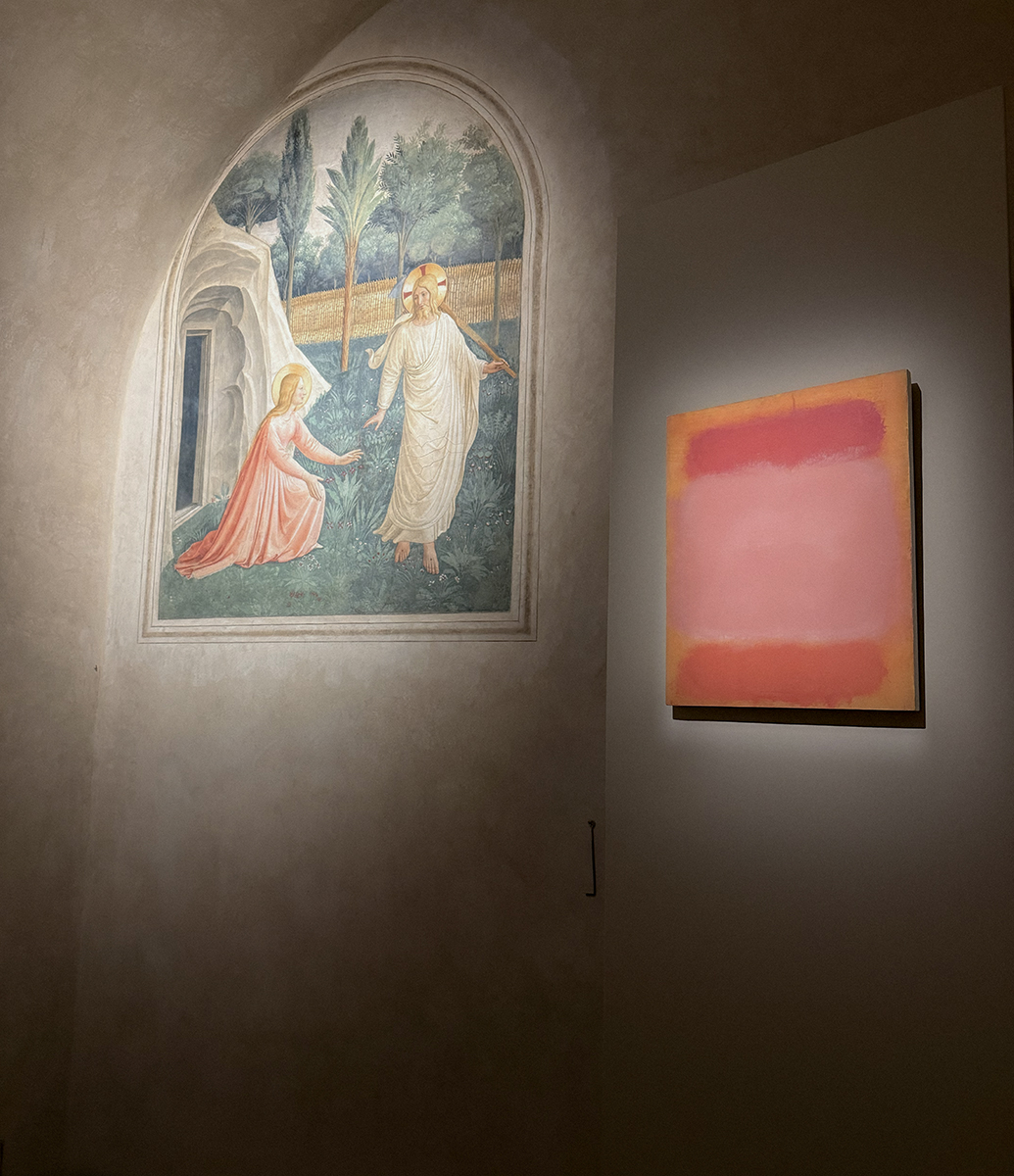
Fra Angelico, with assistance, Annunciation, c. 1439–41, dormitory, cell 3, Museo di San Marco, Florence. Mark Rothko, Untitled, 1954, Private collection. (Rothko a Firenze, exhibition views, Museo di San Marco, Firenze, 2026. Photo Ela Bialkowska, OKNO Studio)
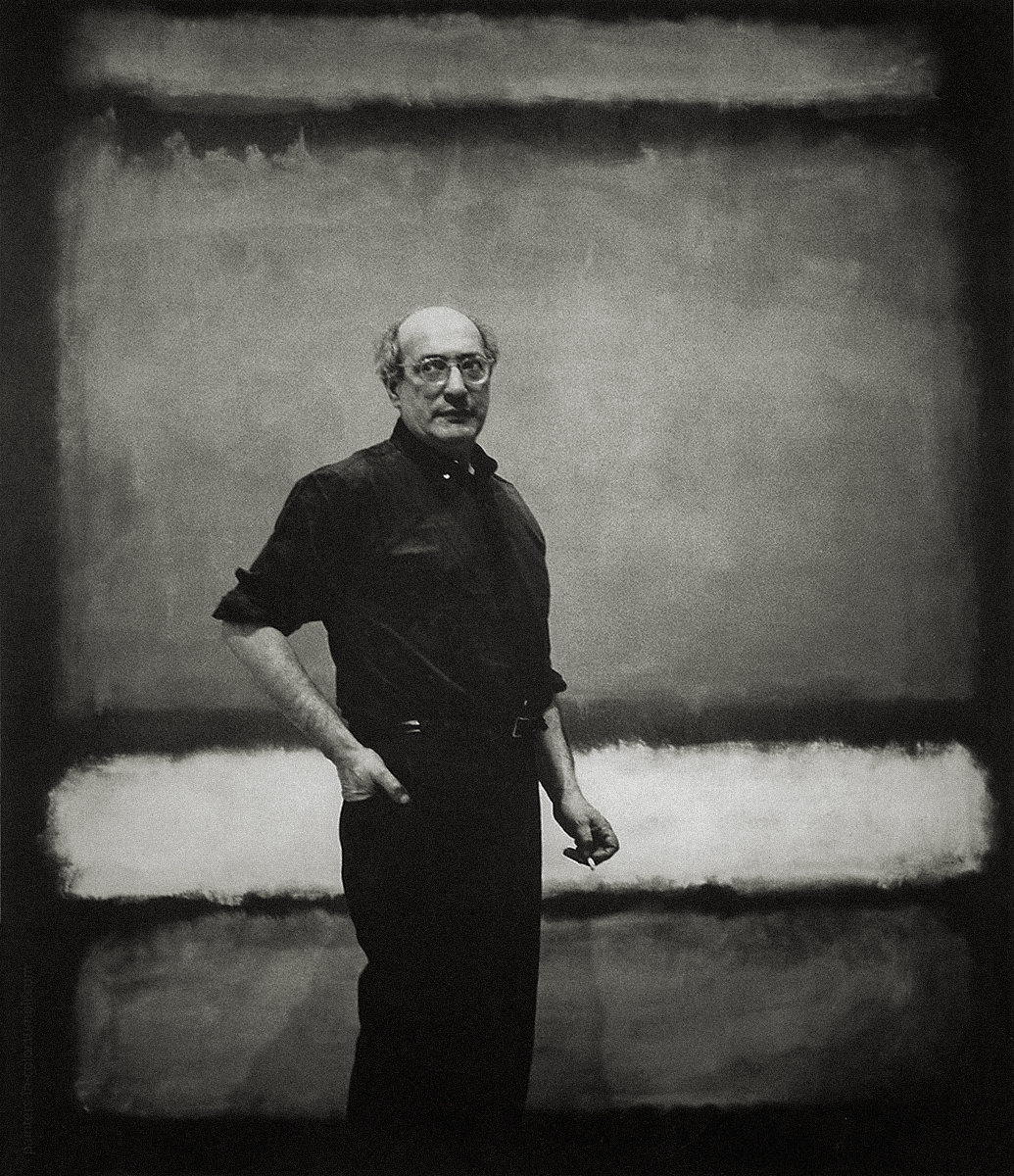
Mark Rothko in his studio, 1961. Photo by Kate Rothko/Apic/Getty Images
The emergence of the dark red and brown tonalities, derived from the weathered reds of Roman walls and the enveloping stillness of those spaces, creates a space of compressed luminosity, evoking a meditation on the endurance of light within darkness. These canvases confront the viewer with a concentrated intensity, and the emotion is held at the edge of darkness. Unlike his previous phases, the gaze upon this series feels heavier, almost in conversation with the most unbearable sensations, that, somehow, provoke solidarity with anyone facing them. The closing is in the somber tones of black and grey, bringing out a strong sense of silence, loneliness, or spiritual peace.
His reading of Søren Kierkegaard and Sigmund Freud informed a deeper exploration of the psychological dimensions of color and space. The paintings are above all chromatic events, as Rothko wanted his images to make their way gradually into consciousness, compelling the viewer’s subjectivity to relinquish every desire for self-assertion in order to surrender completely to that apparition. The work invites anyone who observes it to abandon every attachment, to forget even themselves, and to immerse themselves in another dimension—imaginary, dreamlike.
Abstract forms in art have long been provoking the search for their interpretations. Standing in front of the gigantic canvas covered with unidentified color space, the observer, in his most natural state, is looking for the meaning of such: of what it represents. Partly due to the awareness of art history’s long connection to hidden messages, that made the painting almost impossible to look at, to “understand,” without knowing its deeper context.
Unlike figuration, that lives inside the paradox of the seemingly obvious, while actually being very complex, modern painting comes with a different, almost provocative task: it asks us to look inside. The interaction, known as presence and place, points to the experience that happens only in the direct gazing at the image. Something that occurs only in the present moment, and that is, in its way, “unique” — for everyone encounters it differently. The paintings have no shapes, objects, or figures to look at. It is an abstract space of colour, defined only by the borders of the canvas. Yet, stepping closer, the limits disappear, which is where the personal narration begins. Somehow, the “reputation” makes us wait for the pure sensation, or raw feelings, to get over our mind. Yet, what happens is much more unexpected, and reveals the nature of human emotions. The feelings we sense are directly connected to thought. No matter how hard we might try, we cannot shut down our brain, which constantly searches for associations in familiar things. By observing the surroundings, in one instant the viewer starts noticing the depth of what is beyond his gaze, as if the object in front of him was not the image after all, but an infinite space. The color, after a while, recalls a thought, an association, and, the longer we let it develop itself, the clearer the sentiment becomes.
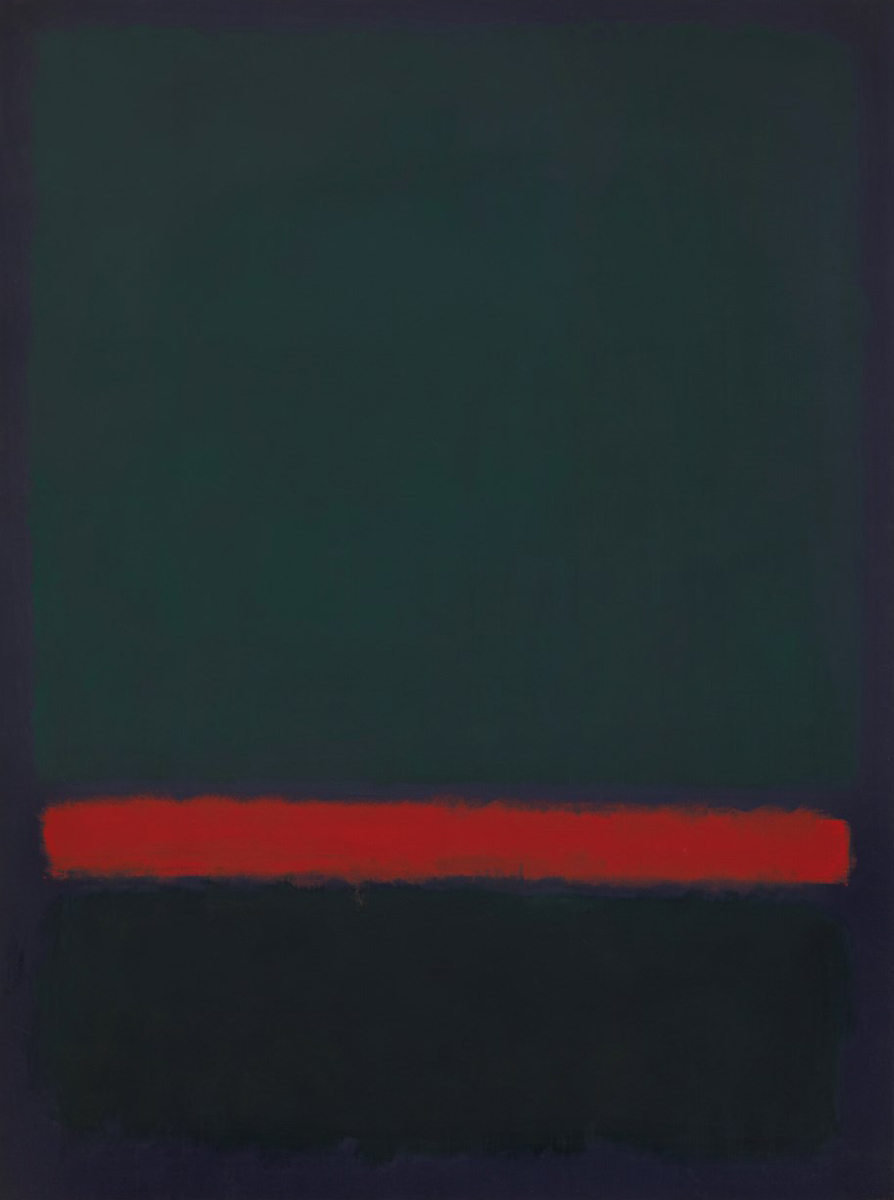
Mark Rothko (1903-1970), No. 15 (Two Greens and Red Stripe), 1964. Oil on canvas. 93 x 69 in (236.2 x 175.3 cm). From The Collection of Agnes Gund. Sold for $98,385,000 in the 20th Century Evening Sale on 18 May 2026 at Christie’s in New York
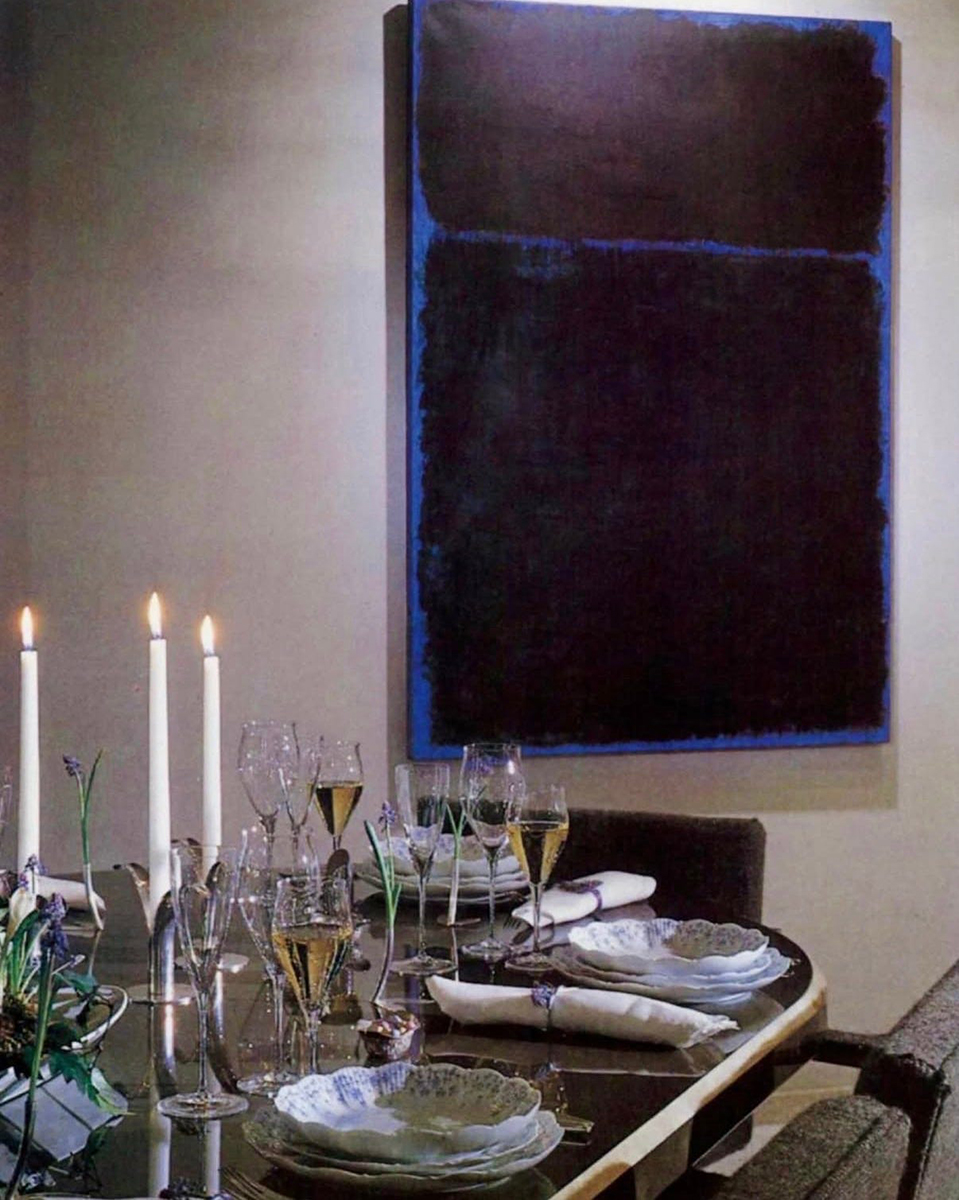
Mr. & Mrs Aron Katz dining-room, 1983
The full saturation of the space recalls a certain memory. While looking across the image, the reflection is getting developed, and the details, no matter how blurred they might have seemed before, are getting clearer in our mind. An association, provoked by the emotional range of the color, continues to create the feeling inside us. As we gaze across the surface, we notice traces of other pigments, or the hazy edges translating to another tone — creating a new reminiscence of the similar emotional spectrum. That way, we get wrapped into the thought of our own mind, reflecting on our own life, facing what we suppressed, and connecting seemingly opposite moments into a wider sense of our personal life, and of our own memoir. Two people standing in front of the same painting describe it in completely different ways, because what they see, or what an image “represents” to them, differs in the same way they vary from each other.
For one person, No. 13 (White, Red on Yellow) might begin as the memory of a summer evening, when the last light settles over the sea and the horizon dissolves into warm bands of gold and crimson. At first, the painting carries the same stillness: the quiet certainty that nothing more is required from the moment than to remain within it. As the gaze wanders, the calm begins to reveal everything that once surrounded it—the awareness that even the most perfect evening passes and fades into reminiscence. The deep red ceases to be only warmth; it becomes the slow weight of longing, spreading gently across the surface without ever overwhelming it. And still, suspended above it, the luminous white interrupts the descent, as the stubborn persistence of possibility. The kind that hopes that some irreducible part of us continues to believe that another evening, another encounter, another beginning remains conceivable. The painting makes space for both serenity and melancholy to coexist inside of us. Just as they often do in life, where beauty is inseparable from the knowledge that it cannot be held.
The meaning is no longer something pre-defined by the author, as was the case during the long period of figurative painting. Instead, it is subjective. It is rather defined in the very moment of interplay — it is something we create for ourselves, based on our own thought, which is why, after all, painting is looking back at us.
Words by Greta Wolff