Shadowplay: What Light Conceals

Collecting Time
July 14, 2026
How Art Makes Us Feel
August 2, 2026"This is our way of thinking: we find beauty not in the thing itself, but in the patterns of light and darkness, and in the designs of the shadows created by the nuances between one object and another. Just as a phosphorescent jewel radiates brilliance when placed in the dark, but loses its charm when exposed to the light of day, so beauty is lost without the effects of shadow.”
– Jun'ichirō Tanizaki, In Praise of Shadows
Light in defining beauty. What do we see when we look at the object in front of us?
The old hairpin on the desk ahead of us. We see its structure, the material it is made of, the ornaments on it. But what we witness is only part of its life—for the view before our eyes is only an image built upon the rays of light falling on its structure.
At first glance, it seems entirely knowable. A thin arc of polished metal catches the morning light before dissolving into a softer grey. Along its spine, tiny engraved lines emerge only where the light reaches them; elsewhere they disappear into shadow, as though they had never existed. One edge appears perfectly smooth until a slight shift in the angle reveals years of minute scratches, the dull patina of oxidised silver, the worn imprint left by fingers that once opened and closed it countless times. Even the small ornament fixed to its end alternates between brilliance and obscurity depending on where the light falls. Nothing about the object itself changes. Only its visibility does.
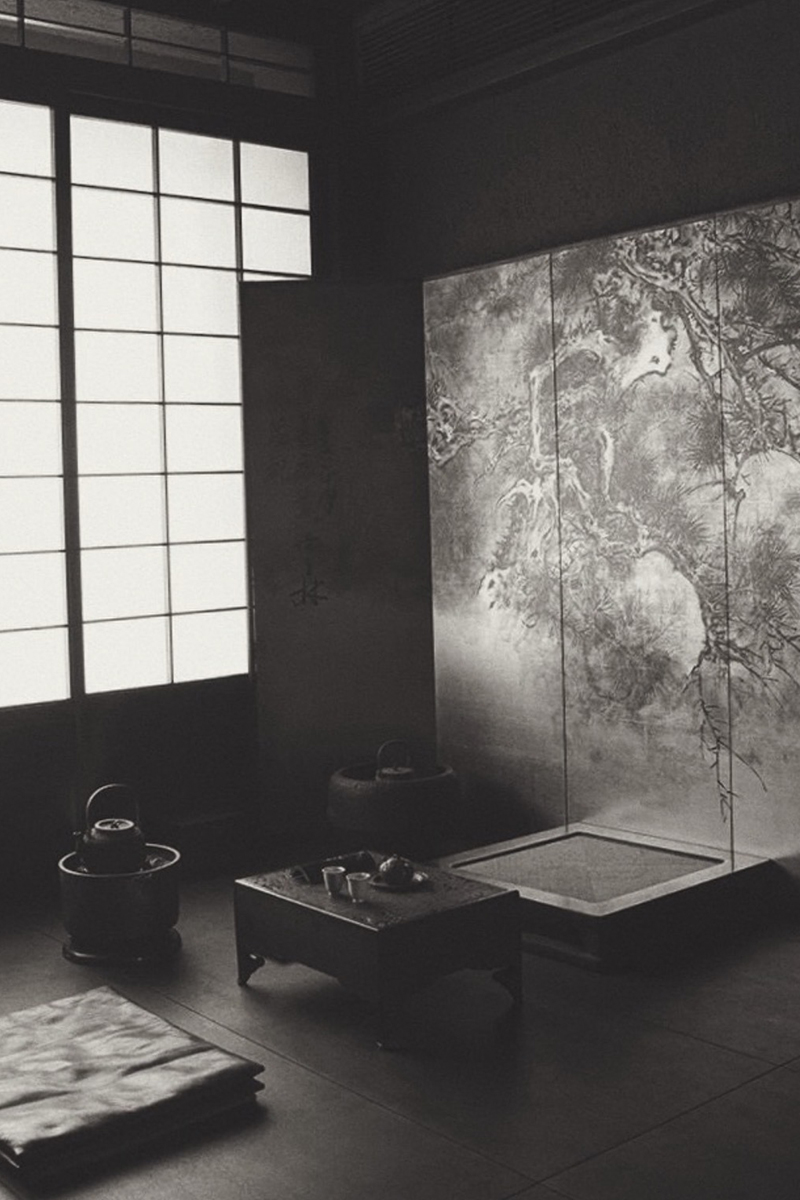
Traditional Japanese Interior with Shoji Screens
Traditional Japanese domestic interior. Location unidentified.
Rather than separating the interior from the outside world, the shoji screens transform daylight into a material of their own. The paper diffuses the sunlight until it loses its brilliance, allowing shadows to settle gently across the tatami, lacquered furniture, and painted folding screen. The room is therefore composed less by architecture than by gradations of light, illustrating Tanizaki's observation that Japanese interiors derive their atmosphere from dimness rather than illumination.
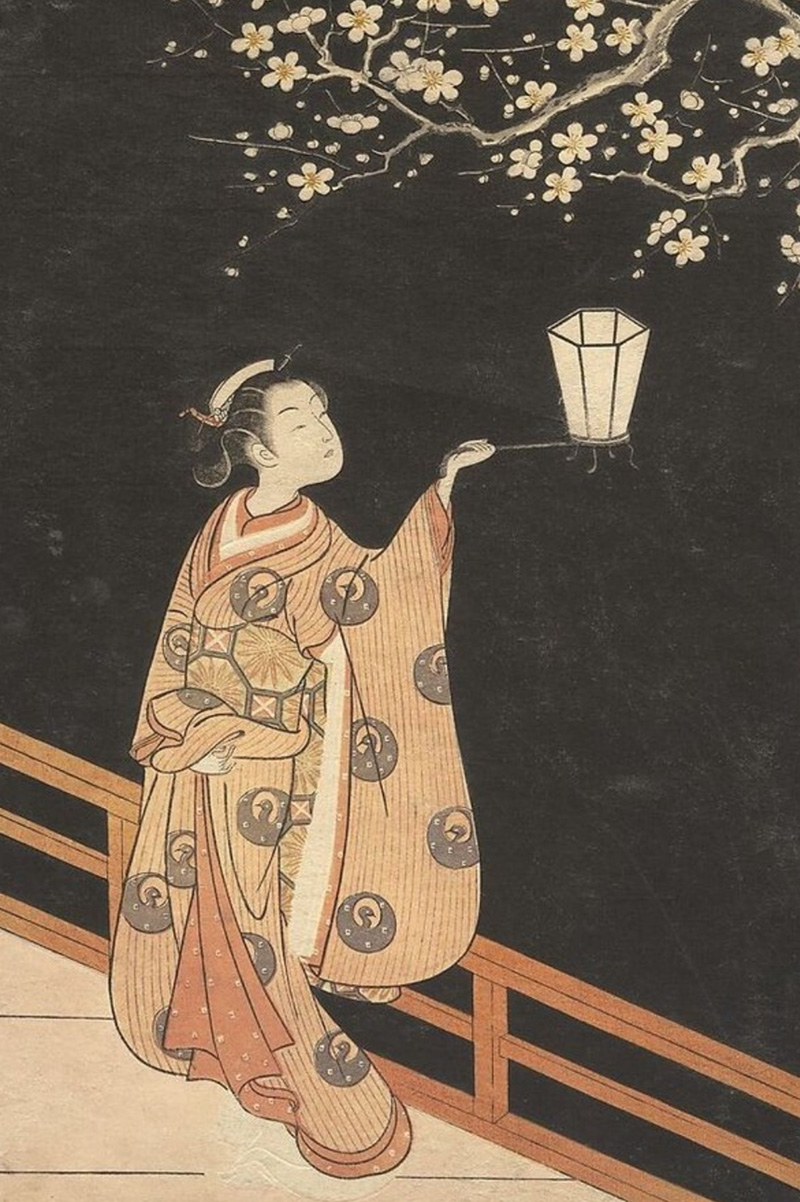
Woman Carrying a Lantern Beneath Plum Blossoms
Suzuki Harunobu, c. 1766. Colour woodblock print (nishiki-e). Edo period.
Night in Japanese art is rarely treated as darkness alone. Here, Harunobu stages a quiet reversal: the lantern does not conquer the night but merely negotiates with it. Its modest glow illuminates only fragments of the woman's figure, leaving the surrounding garden to dissolve into an atmosphere of suggestion. The plum blossoms seem to hover between visibility and disappearance, reminding us that beauty often resides not in complete revelation, but in the delicate balance between what light grants and what darkness preserves.
Credits: Public domain.
The object has its own reality. We, being mere observers, are limited to only one part of it—the visual one. By the way light illuminates it, we can see its form, understand its structure, and judge its aesthetic value. We tend to name it "beautiful" or, on the contrary, "ugly," based on the same way it is illuminated, as it is precisely the light that constructs the picture inside the brain and, accordingly, allows us to define the item in front of us. The projection is completely ours. The opinion of its beauty as well.
Many things in the Occident leave scope for further development through the Eastern conception thereof. Speaking of beauty, one cannot but enter the controversy long before finding a definition of the term. Is it subjective? Or, at least, can we really argue that what "we like," according to our understanding, is as we see it, or that the very way of seeing it depends on many factors of our own history? Apparently, one can hardly separate taste from the cultural coherences into which the same taste has been put. In the West, admiration is based on the obvious, on what is in front of us, what is "certainly" there, present, in physical form. According to Tanizaki Jun'ichirō, the Oriental way of seeing allure is, by all means, in the mystery of what is hidden. While the West is obsessively looking for clarity and definition, the East allows more shadowplay, knowing that there is a whole world in the absence of light. Looking back at the object ahead of us, we get to notice the gallant show happening right before our eyes. For every aspect of its shape that we note is actually there because of the shadow that outlines it. There are two ways of perceiving anything. So it is with the ways of discerning. While the first, the one admiring light, seeks to have a secure image, the other one allows the imagination. The shadow still holds the truth, yet the way we see it is based on the remembrance we have of it.
The light adorns objects. It allows us to observe them, to remember their physical aspect, and, among all else, to admire them and spot what we find dazzling after all. Nevertheless, at its core, it is final; it is too distinct, even limited. Reality holds both: the parts we know were "actually there," seen by our sight, and those imagined. Which is why the East, being comfortable with not knowing, with not having certainty, has embraced the shadow as the arbiter: the one that makes sight enigmatic. In this case, we, as observers, no longer rely on the impulse of our craving to gaze, as we are free to allow imagination to hold the narration for us—and with it, memory itself. Arriving at another point of deep fascination with sight and comprehension, the shadow challenges us to remember the object the last time we looked at it in the light: to recall every aspect of its form, its imperfections, and the details of its structure. Needless to say, when we remember it, the image created is based on the way light digested it.
Shadows in shaping objects, in defining them, and how what is not seen leaves a trace on the imagination, or on the memory of what we thought it was like. Every shadow establishes a threshold between what has been witnessed and what must be inferred. It is precisely at that threshold that memory begins its work, returning to previous encounters in an attempt to complete what the present moment withholds.
Unlike Western certainty, the East embraces what remains hidden, unsaid, or imagined, if not more than what was obviously put before our sight. The light is evident. The shadow, conversely, asks for personal interrogation. It is no longer the bond formed between the entity and the onlooker, as it turns into the ongoing dialogue between the two, including the role of the one standing between them: the memory we have of the item in front of us.
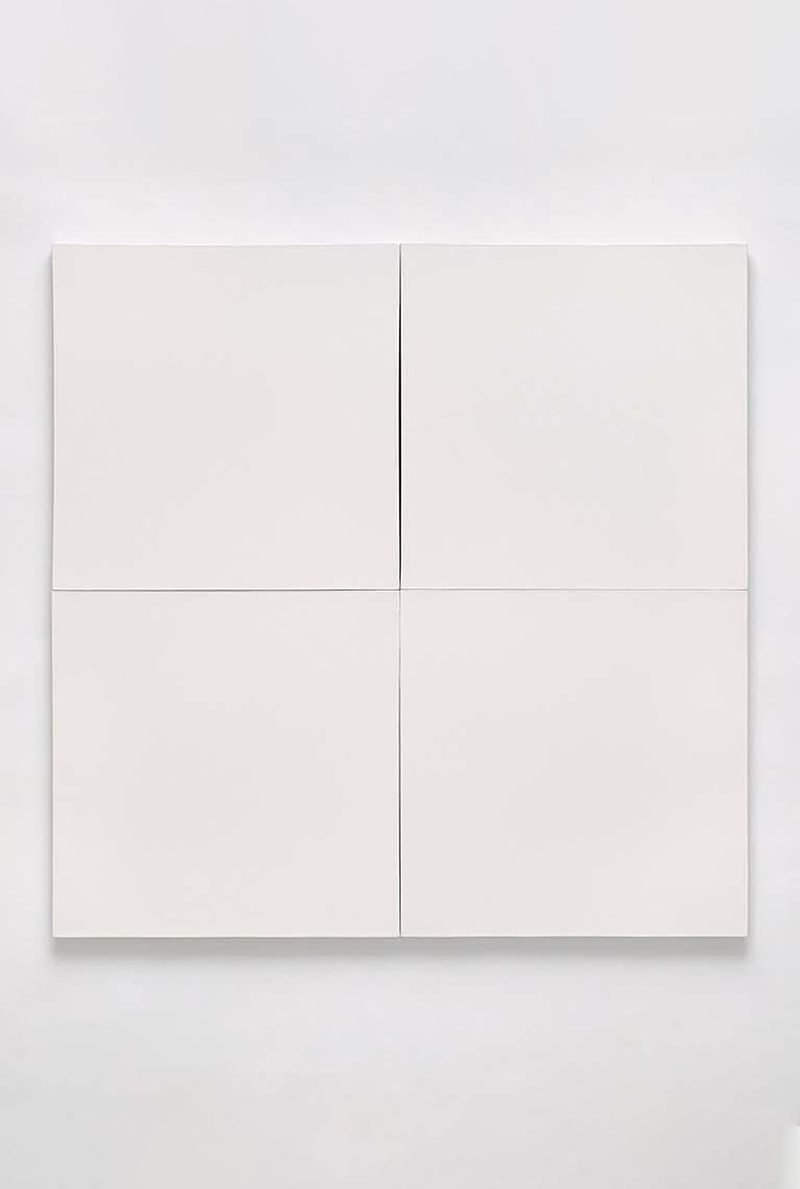
White Painting
Robert Rauschenberg, 1951. Oil and enamel on canvas. Series of monochrome paintings. Robert Rauschenberg Foundation.
At first appearing entirely blank, the White Paintings reveal themselves as constantly changing surfaces. Rather than presenting an image, they register the conditions surrounding them: shifting daylight, passing shadows, airborne dust, and the movement of viewers. The paintings therefore transform absence into presence, proposing that emptiness is never truly empty but continually shaped by the world around it. In doing so, Rauschenberg redefined the artwork not as a fixed image but as a site where perception itself unfolds.
Credits: Image courtesy of the Robert Rauschenberg Foundation.
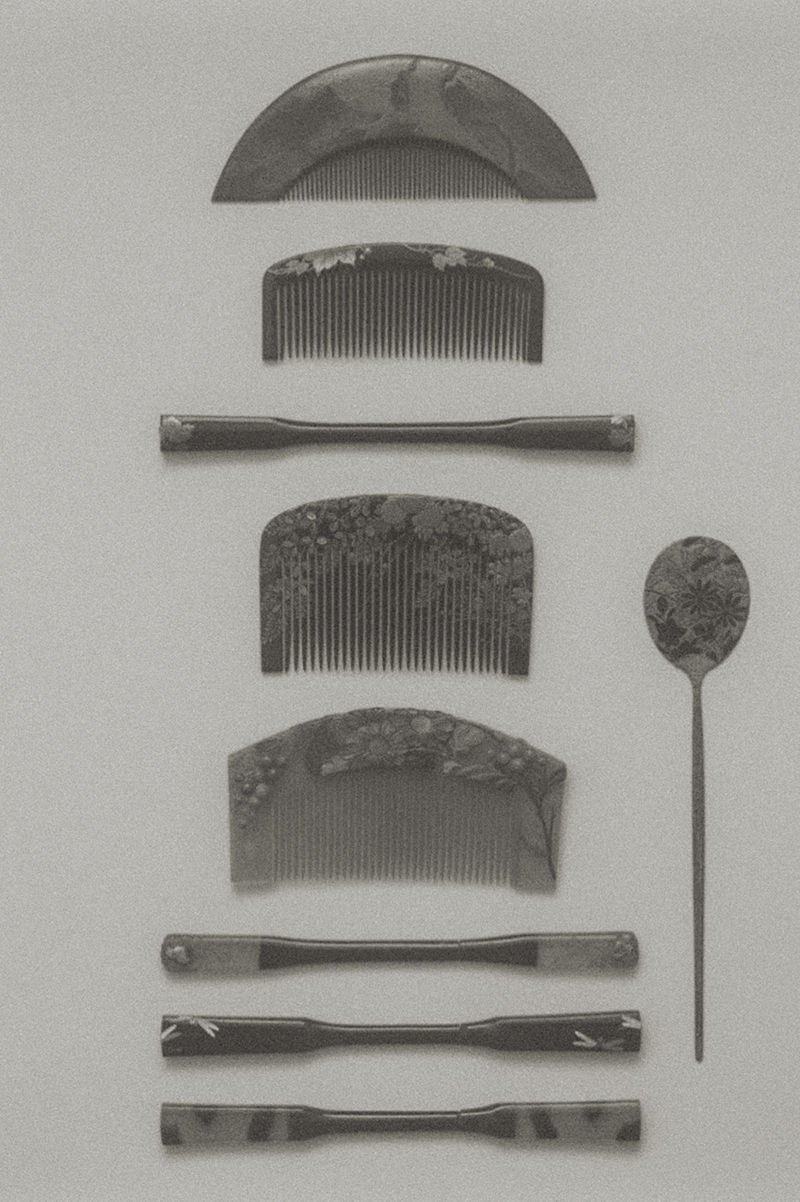
Lacquered Hair Accessories
Japan, probably Edo–Meiji periods (18th–19th century). Collection unidentified.
“The quality that we call beauty ... must always grow from the realities of life.” ― In Praise of Shadows
Connection to modern art.
Somewhat ironically, what is not there, what is absent, is considered inexistent. As we are so used to seeing things, we do not discern the concealed object as the real one. The truancy of the light does not conclude that the object does not exist—it only shows that its beauty and its form are away from the observer's sight. Remaining in the darkness, its characteristics are still present; only our ability to observe it, or to understand it, points to our own limitations, certainly not to the object itself. And yet, is there even such a thing as nothingness?
Modern art, especially through Minimalism and conceptual tendencies, had long aspired to move in that direction. Starting with Yves Klein's The Void (often called Le Vide), the 1958 exhibition at Paris's Galerie Iris Clert, taking form in Robert Rauschenberg's White Paintings, which are, needless to say, one of the "provocations" within the history of art, of particular interest for narrating the ways of seeing and monitoring the visual world. The set of canvases, painted completely white, reflected shadows—which was precisely the reason why they did not seem empty at all. Named "airports for the lights, shadows, and particles," the series first introduced the painting as the object on its own.
Following him, his friend and colleague John Cage composed 4′33″, a composition of four minutes and thirty-three seconds of silence. The inspiration took form after visiting a room at Harvard University designed to be entirely free of external sound. Instead of the expected quiet, what he heard were his own thoughts, the beating of his heart, and the sound of his blood circulating. This led to the realization that absolute silence was impossible to achieve. There is no such thing as nothing, for everything has something. This observation was, in essence, made long before in the Orient, called liú bái (literally, "leaving blank"), naming a foundational principle in traditional Chinese painting and poetry, utilizing expansive negative space to emphasize that emptiness holds just as much importance and meaning as what is physically drawn.
The way of observing the surroundings is, by all means, learned and culturally transmitted. What is considered to be "silence" is the absence of sound, yet what holds the same term in the visual milieu refers to the "absence of form," or even the "absence of shadow," for when imagining "nothingness," we, like Rauschenberg, see white spaces, the "holes between the letterforms" that facilitate our reading, or the gaps between the musical notes that are as important as their dark form.
However, the same absence happens in comprehending the shadow. In the darkness of the room, we might not be able to sense the objects inside it, whereas the way it falls upon the space itself certainly does define it. By finding oneself in a dark interior during the nighttime, one starts observing the forms. They are not "existing" at all. They are just the manifestation of missing light in the corridors of the space. As time passes, they change, covering different areas and, therefore, shaping diverse outlines around us. Similar to the idea of "absolute silence," which is, apparently, a mythical projection of the abstract points of the mind, while the only experienced one is subjective. There is always a sound; there is always a thought. The same articulation applies to the absence of light: the shadow holds not only hidden objects, as it forms a completely different visual reality.
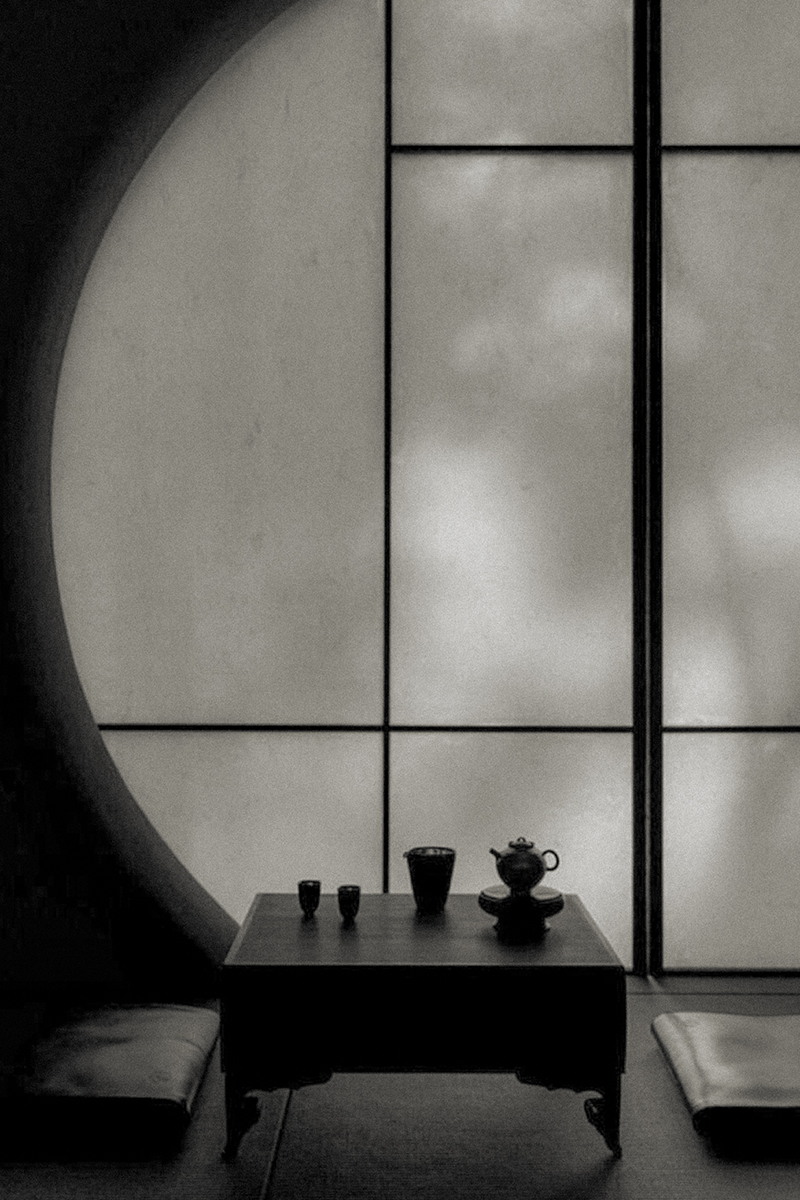
Tea Setting Before a Shoji Window
Traditional Japanese interior. Location unidentified.
The tea utensils occupy only a small portion of the room, yet the surrounding emptiness gives them their presence. Framed by the circular opening and the softly illuminated shoji, the composition demonstrates how Japanese interiors privilege intervals over abundance. The objects do not command attention through ornament but through their relationship with the surrounding shadow, where silence, light, and empty space become equally active participants in the experience.
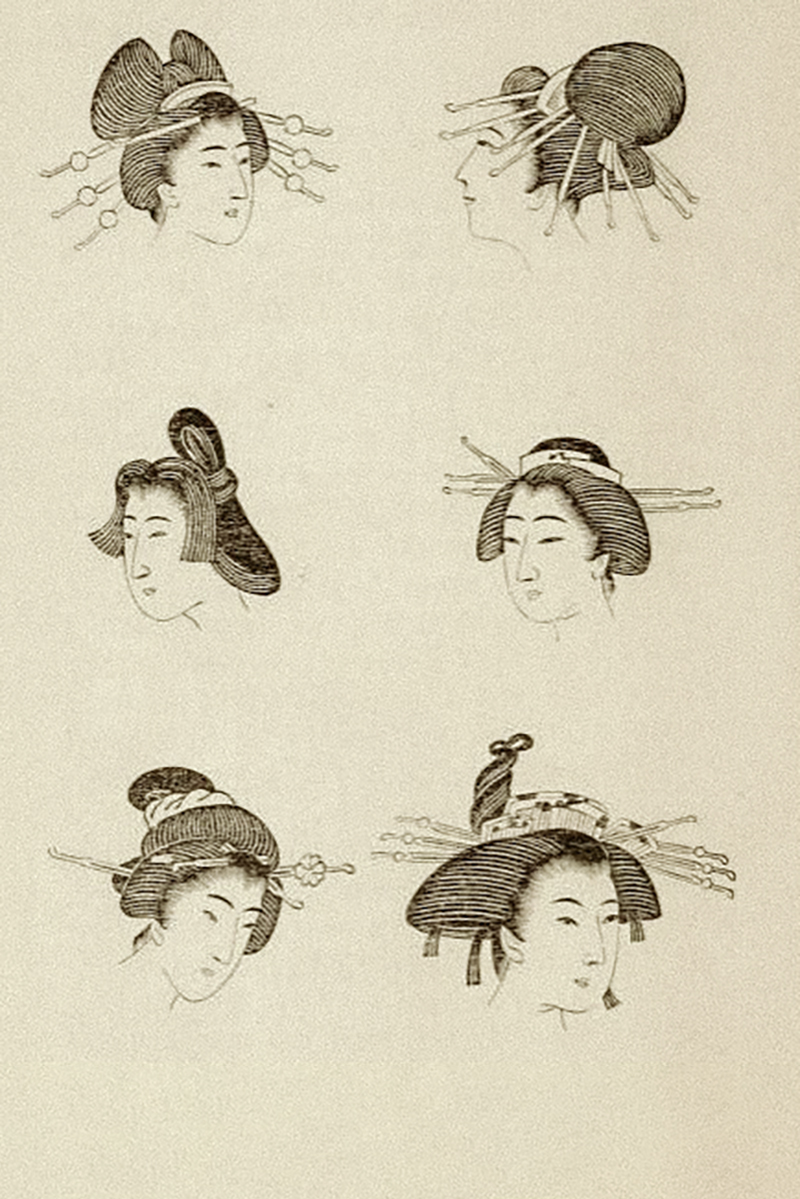
Variations of Kanzashi Hairstyles
From Japanese Girls and Women by Alice Mabel Bacon. Meiji period, c. 1901. Public domain.
The kanzashi was never merely an ornament but an extension of the wearer's identity, signalling age, social status, profession, and occasion through its form and arrangement. Worn within elaborately dressed hairstyles, these hairpins transformed the act of adornment into a carefully composed balance between decoration and restraint. Their slender silhouettes also demonstrate how Japanese aesthetics often privileged refined linearity over excess, allowing even the smallest accessory to shape the visual harmony of the whole figure.
Credits: Illustration from Japanese Girls and Women by Alice Mabel Bacon, c. 1901. Public domain.
Beauty of imperfection. There has always been a certain admiration for what is there, what is obvious, what is seen.
"And yet we love things that bear the marks of soot, weather, and age; we love the colours and the lustre that call to mind the past that produced them."
Beauty, then, is no longer located in perfection itself but in the traces that perfection leaves behind as it slowly disappears. Patina does not conceal the object's beauty; it becomes part of it. Time, rather than diminishing the object, completes it.
An Edo-period black lacquer writing box never offers itself in its entirety. Unlike polished metal, which immediately returns light to the observer, lacquer absorbs it, releasing only restrained reflections from its surface. The sprinkled gold of maki-e decoration does not appear simultaneously. Certain motifs emerge only as the viewer shifts position, while others quietly recede into darkness. The object therefore refuses the immediacy of recognition. It replaces certainty with succession, requiring beauty to unfold gradually rather than announce itself at once.
This is why shadow and imperfection belong together. Neither offers the satisfaction of complete knowledge. Instead, both invite contemplation rather than consumption. They ask us not simply to look at an object but to dwell with it long enough for what cannot be immediately seen to begin revealing itself.
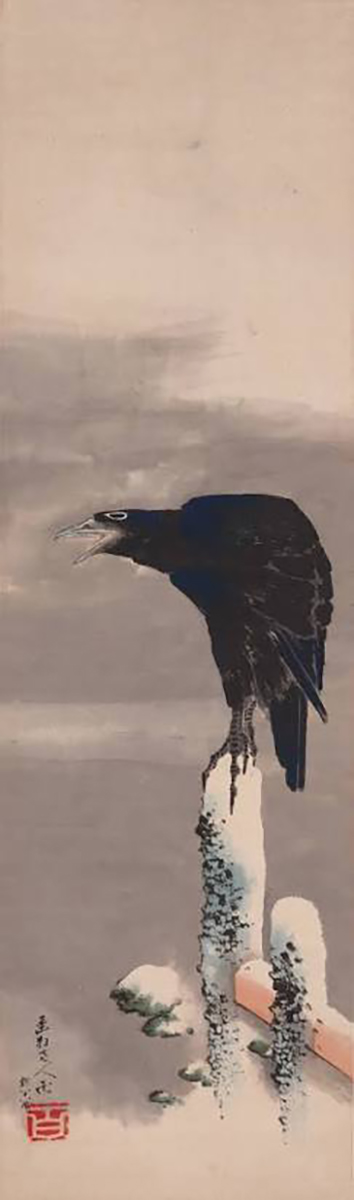
Raven in Snow
Katsushika Hokusai. Edo period, early 19th century. Hanging scroll, ink and colour on silk. Museum collection varies by version.
Reduced to only a few essential forms, Hokusai's raven demonstrates the expressive power of restraint. Vast areas of untouched silk surround the solitary bird, allowing emptiness to become an active component of the composition rather than a neutral background. The contrast between the deep black plumage and the pale atmosphere heightens the work's quiet tension, illustrating the Japanese conception that absence, silence, and shadow possess the same visual authority as the painted form itself.
Credits: Raven in Snow, Katsushika Hokusai, Edo period, early 19th century. Public domain.
Words by Greta Wolff
Does the beauty of objects lie in the forms we see, or precisely in those that remain unseen?